
Side-by-Side Comparison
Self-Setting Wall Clocks


Open the full side-by-side comparisonSee the full criteria table for all top picks when you need the extra detail.Show detailsHide details
Check List On The Best Self-Setting Wall Clocks

Bulova 12.4-Inch Wooden Atomic Wall Clock
Premium wooden case with accurate atomic syncOverview
Bulova's warm-brown cherry wall clock is a 12.4-inch round analog atomic model with wood material, modern styling, and battery-powered operation.
Key Features
- Format: size 12.4"W x 12.4"H, an Analog display, and Warm Brown Cherry coloring.
- Bulova specifies one required AA cell for the battery-powered atomic wall clock; it is not included.
- The wall-mounted body weighs 1.89 pounds and requires one AA battery; the battery is not included with the selected clock.

Considerations
The atomic label does not state the radio standard, supported time zones, signal coverage, daylight-saving override, or manual-setting fallback. Confirm those functions before ordering, especially outside the intended broadcast region. Also check whether the case is solid wood or a wood component, complete depth, lens material and reflections, hand contrast, movement sound, rear hanger, supplied wall hardware, battery-door access, and the procedure used when reception is weak.

Best choice&check Bulova 12.4-Inch Wooden Atomic Wall Clock
Bulova Atomic Time 2 Analog Wall Clock C5004 | 12.4" Wooden Frame, Sets Time Automatically | Quartz Movement | Battery Operated | Classic Design

La Crosse 12-Inch Atomic Analog Clock
Reliable self-setting analog for most roomsOverview
La Crosse Technology's black 12-inch atomic wall clock is a classic round analog model with programmable, multiple-time-zone, and daylight-saving feature fields.
Key Features
- Room fit: size 12"W x 12"H, an Analog display, and Black coloring.
- Installation: batteries: one AA battery is required, batteries included: No, and mounting Wall Mount.
- The plastic wall-mounted clock weighs 1.7 pounds, needs one AA battery, includes no battery, and lists atomic operation rather than ordinary manual timekeeping.

Considerations
Confirm the supported transmitter and selectable time zones, the daylight-saving on/off control, manual setup, reset sequence, and behavior when no signal is received. The product details do not specify reception range, complete depth, lens material, movement sound, rear hanger, or supplied fastener. Buyers outside the clock's radio region should verify that it can be set and kept manually instead of assuming the atomic function will work worldwide.

RecommendedLa Crosse 12-Inch Atomic Analog Clock
La Crosse Technology WT-3129B 12 Inch Atomic Analog Wall Clock, Pack of 1, Black

WallarGe Atomic Clock with Outdoor Sensor
Shows indoor and outdoor temps with atomic accuracyOverview
This WallarGe model is a 10.6-inch-wide digital atomic clock with a seven-inch height, an outdoor sensor, alarm, daylight-saving controls, and temperature display.
Key Features
- Case: size 10.6"W x 7"H, a Digital display, and Gray coloring.
- WallarGe specifies five required AA batteries for the atomic clock and outdoor-sensor system; none are included.
- The 1.3-pound rectangular unit can be wall mounted and requires five AA batteries; none are included for the clock-and-sensor system.

Considerations
The listing does not allocate the five batteries between the main display and outdoor sensor or state sensor range, additional-sensor support, atomic signal region, time zones, or manual fallback. Confirm those details, temperature units, sensor weather protection, alarm schedule, display contrast, backlight behavior, and whether readings remain visible continuously on battery power. The indoor/outdoor field should not be treated as permission to expose the main clock to weather.

High qualityWallarGe Atomic Clock with Outdoor Sensor
WallarGe Atomic Clock with Outdoor and Indoor Temperature - 12.5 Inch Self-Setting Digital Clock Large Display, Battery Operated Wall Clocks or Desk Clocks for Bedroom, Livingroom, Office

WallarGe Atomic Large LCD Clock
Large display ideal for classrooms and officesOverview
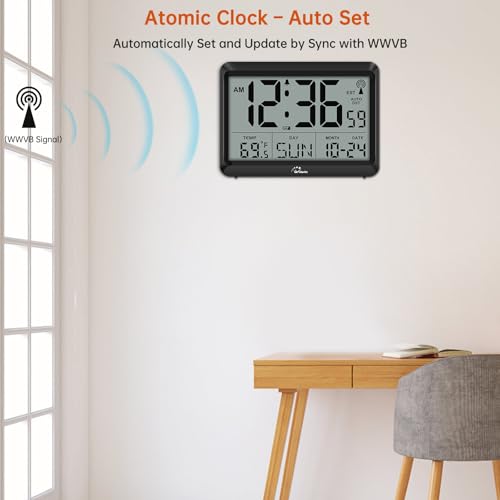
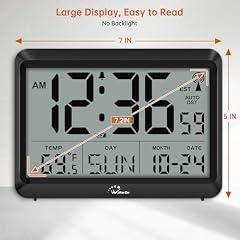
WallarGe's black digital atomic clock combines a large LCD, temperature display, multiple time zones, daylight-saving control, and either tabletop or wall-mounted placement.
Key Features
- Profile: size 7"W x 5.2"H, a Digital display, and Black coloring.
- Power arrangement: batteries: 3 AAA batteries are required, batteries included: No, and mounting Tabletop, Wallmount.
- The listed body measures 7 inches wide by 5.2 inches high and weighs 0.5 pounds, while a separate size field calls the model 8.5 inches.
Considerations
Resolve the 7-inch body entry versus the 8.5-inch size label before choosing a shelf or wall location. Three AAA batteries are required and not included. Confirm the received radio standard, supported zones, daylight-saving override, manual setup, signal indicator, alarm controls, temperature units, backlight duration, viewing angle, stand stability, rear hanger, and whether the display remains continuously readable without pressing a light button.
WallarGe Atomic Large LCD Clock
WallarGe Atomic Digital Wall Clock Battery Operated, Self-Setting, Large Display with Temperature, Date, Day of The Week, Silent Wall Mount Digital Clock, 4 Time Zones, DST

Bluetooth Auto-Sync 15-Inch Digital Clock
Large, phone‑syncing display for modern homesOverview
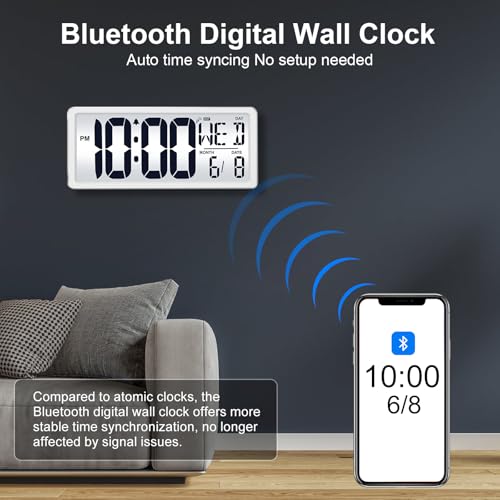
The Xflyee clock uses Bluetooth auto-sync rather than a named atomic receiver and combines a large white digital display with adjustable brightness, adjustable volume, alarm, and timer functions.
Key Features
- Dimensions: size 14"W x 5.9"H, a Digital display, and White coloring.
- Connection: batteries: 4 AA batteries required. (included), batteries included: Yes, and mounting Wall Mount/Desktop.
- Its body entry is 14 inches wide by 5.9 inches high, while the size label says 15 inches; four included AA batteries power wall or desktop placement.
Considerations
Confirm the phone platform, app, permissions, pairing recovery, offline manual setup, time-zone changes, and whether four batteries run the display continuously. Resolve the 14-inch versus 15-inch difference, then check depth, stand or hanger hardware, alarm schedules, timer controls, brightness, volume, and reset behavior. Buyers avoiding app dependence should verify that essential clock functions remain usable from physical controls.

Bluetooth Auto-Sync 15-Inch Digital Clock
Bluetooth Time Sync Digital Wall Clock Battery Operated with Backlight, Auto DST Large Digital Wall Clock with Day, Date & Temperature, 15'' Large Digital Clock for Home, Bedroom, Office

Geevon 12-Inch Atomic Analog Clock
Affordable self-setting analog with simple stylingOverview
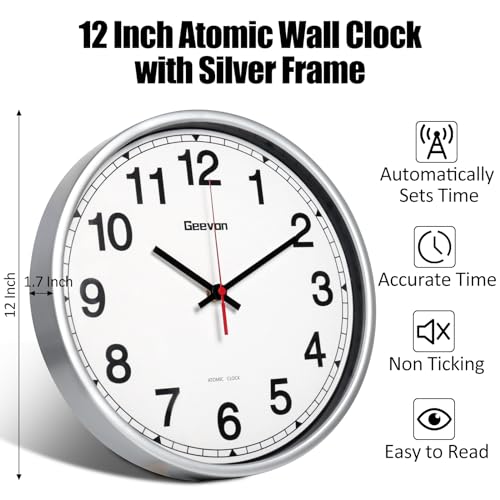
Geevon's silver 12-inch atomic wall clock uses an analog white dial, black numerals, four selectable time zones, and a daylight-saving setting.
Key Features
- Build: size 12"W x 12"H, an Analog display, and Silver coloring.
- Placement: batteries: one AA battery is required and listed as included, batteries included: Yes, and mounting Wall Mount.
- One AA battery and a wall hook are included; the plastic-and-glass wall clock weighs 1.6 pounds.
Considerations
Confirm the received radio standard, supported regions, manual-setting fallback, daylight-saving switch, reset process, wall-fastener suitability, and rear clearance before installation. The included hook still needs to match the wall material and verified load. Glass can add reflections, and indoor use is the stated placement, so do not treat the case or face covering as evidence of weather protection.

Geevon 12-Inch Atomic Analog Clock
Geevon 12 Inch Atomic Wall Clock - Self-Setting Analog Clock with Automatic Time Sync - Battery Operated for Home Office School - Silver Frame
Which clocks synchronize by radio and which use Bluetooth?
Bulova, La Crosse, both WallarGe clocks, and Geevon are presented as atomic or radio-controlled models. Xflyee instead names Bluetooth auto-sync, which introduces a phone, app, pairing, and permission dependency. These methods are not interchangeable: radio clocks need a compatible transmitter and zone, while Bluetooth needs supported software and a working connection during setup. Confirm the exact synchronization method, manual fallback, resync behavior, daylight-saving control, and what happens when the signal or phone is unavailable.
How do region and time-zone controls affect atomic operation?
An atomic label does not guarantee reception in every country or even every selectable time zone. La Crosse explicitly lists multiple zones and daylight-saving functions, while the other radio models still need their transmitter region, zone range, override, and weak-signal procedure confirmed. Geevon identifies atomic analog use but also requires these checks. Buyers outside the intended radio footprint should verify manual setting and continued quartz operation. Place radio clocks away from likely interference and allow for their documented reception cycle.
When are sensors and large digital displays useful?
The larger WallarGe model adds an outdoor sensor and temperature data, while the smaller WallarGe LCD combines temperature, alarm, multiple zones, and flexible tabletop or wall placement. Xflyee offers a much wider digital display with alarm, timer, brightness, and volume controls. Bulova, La Crosse, and Geevon keep conventional analog faces. Decide whether temperature and alarms justify extra controls, then verify sensor range, units, viewing angle, backlight behavior, stand stability, and legibility from the intended room position.
What power and mounting details should be settled first?
The analog radio clocks use AA cells, the compact WallarGe LCD uses AAA cells, and the sensor system requires several AA batteries across its components. Xflyee lists included AA batteries but still needs continuous-display behavior confirmed. Wall mounting adds hanger and fastener questions; tabletop use adds stand depth and stability. Check cell allocation, battery inclusion, replacement access, low-power indication, display or alarm continuity, complete case depth, rear hanger, supplied hardware, and clearance for sensor placement before choosing a location. Record the manual-setting steps before relying on automatic synchronization away from home.
Final Thoughts
Bulova 12.4-Inch Wooden Atomic Wall Clock is the first pick for buyers who want a wood case with WWVB time synchronization. Check the listed dimensions, battery requirements, DST controls, and signal-reception guidance for the intended room.
La Crosse 12-Inch Atomic Analog Clock is the simpler analog alternative in the current list. Compare dial contrast, case finish, DST behavior, and manual-setting fallback rather than assuming radio reception will be equally strong in every building.
Related Articles



Latest Review Posts


Self-Setting Wall Clock For Sale
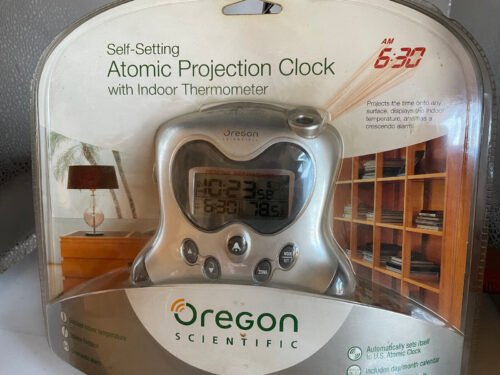
new self setting atomic projection clock digital Oregon scientific
 eBay
eBayNew Self setting atomic projection clock with indoor thermometer Oregon scientific Display indoor temperature thank you for looking