
Blog layout help shoppers choose a timepiece that fits their home, routine, and budget. This guide explains the most important details to compare before buying, including design, readability, movement type, materials, size, power source, and everyday usefulness. A good clock should do more than display the time; it should also fit the room and make daily life easier. Whether you are shopping for a bedroom, kitchen, office, living room, or travel bag, we keep the advice simple and practical so you can find a reliable clock with confidence. The goal is to give you a quick, helpful starting point so you can move from search results to a confident decision without wasting time.
Blog About Top Of The Best Modern Clocks

Compare Large Decorative Wall Clocks using movement type, movement noise, overall diameter, viewing distance, and dial readability at the intended distance.

Check What the Batteries Actually Power For a wall without an outlet, choose a digital clock whose batteries power the normal display. Backup batteries may …

Heavy sleepers often fail to wake to regular alarms because waking is not just a matter of loudness. Two physiological concepts explain this: sleep …

Tiny digital clocks solve different space problems: a stick-on dashboard display, a compact travel alarm, or a bedside clock that leaves room for a phone and …
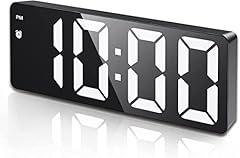
Desktop Digital Clocks are useful for offices, bedrooms, shelves, and workspaces where time needs to be visible without taking over the room. This guide …

Compare nine 30- to 49-inch wall clocks by visual scale, readability, mounting needs, weight, style, and documented limitations before choosing a living-room …

Compare 8 alarm clocks with built-in noise machines by alarm scheduling, sound duration, display blackout, app or local controls, and outage behavior.

Compare six alarm clocks by verified alarm count, repeat rules, independent controls, snooze behavior, and power-failure operation.

Choosing a smart display for the nightstand starts with priorities — visibility, sound, privacy, and how much intelligence should stay on the …

A purpose-built AA organizer does more than tidy a junk drawer: it protects cells, preserves capacity, and speeds selection. Individual compartments …

Start with the basics: get the clock’s weight on a scale and determine how it hangs. Small errors here multiply into anchor failures. Quick …

Why plating and material choice matter Electrical contact performance is driven by both conductivity and corrosion resistance. Copper alloys …

Most household wall and mantel clocks are very low-drain devices. Basic quartz movements and analogue stepper motors typically draw tens to a few …

Which clock types accept 1.2V cells Most quartz movements found in wall clocks and simple mantel clocks run reliably on 1.2V NiMH cells because …

Can a Bunny App Outsmart the Snooze Button? Wake-up tools that actually get kids moving (without bribery). Mornings are a battlefield. Little feet, big …

Compare fancy alarm clocks by the features used every morning: alarm scheduling, volume, display dimming, control layout, power source, and backup behavior. …

For fancy wall clocks, compare exact dimensions, listed weight, dial contrast, movement noise, mounting hardware, and finish. Decorative gears, mirrors, or …

Funny alarm clocks for heavy sleepers may use movement, puzzles, rolling cases, or unusual alert sounds. Compare the actual wake-up method, volume controls, …

For mirrored wall clocks, compare the mirror material, full dimensions, listed weight, hand and numeral contrast, and mounting hardware. Check seller photos …

For LED wall clocks, compare digit size, viewing angle, brightness range, power-cable requirements, remote controls, and mounting hardware. Check readability …

Start by planning: gather soft, non‑marring tools and a caliper or small ruler. Work over a tray so tiny nuts or washers aren’t lost. Removal …

Identifying the movement’s shaft type is the essential first step because the hole diameter and profile on a spade hand must physically match the …

A 400‑day uses a slender vertical suspension spring as a torsion element: when the pendulum rotates, the spring produces a restoring torque …

“Quiet” is not a single trait — it’s a combination of several distinct sounds and how strongly the case transmits them. Identifying the source makes …

Small dials require precise measurements to avoid hand rubbing. This protocol defines exposed shaft and total shaft, shows how to measure threaded …

Quarter progression and hour strike The Westminster melody is built from four sequential four‑bar phrases that play progressively: the 1st quarter …

Minute hand length is limited not only by dial radius but by where the movement’s pivot sits relative to the dial plane. Two small measurements …

A quick visual triage separates three movement families and shows immediate replacement consequences. First look: visible clues Battery / …

Shaft length is not just a number on a spec sheet — it controls whether the movement actually fits the dial and whether the hands clear and look right. …

Understanding the pivot hole sizes is essential to confirm hand‑to‑movement compatibility. Record actual inside diameters, any tapers or …