

Time, Sleep & Wake-Up Guides
Do not shop for a louder alarm until you know which part of the morning is failing.
Some mornings fail because bedtime is too late. Some fail because the phone stays in bed. Some fail because the wake-up cue is wrong for the room. Some fail because a child cannot see the morning schedule. Some fail because the clock is showing the wrong time after travel or daylight saving time.
Use this hub as a decision map: start with the problem, open the right TOPCLOCKS guide, then compare clocks only when a clock solves the next step.

Start Here
| If this is happening | Start with this guide | Clock setup to consider | Don't buy yet if… |
|---|---|---|---|
| You know your wake-up time but not your bedtime | Sleep Calculator | Basic bedside alarm clock | The schedule gives you too little sleep |
| You wake up tired after enough time in bed | Why Do I Wake Up at 3 AM? | Dimmable bedside clock | You snore, gasp, or feel sleepy during the day |
| You hit snooze without thinking | Stop Hitting Snooze | Across-room alarm, second alarm | Snooze is covering chronic short sleep |
| Your phone keeps you awake | Phone Alarm vs Alarm Clock | Digital bedside clock, analog alarm clock | The phone still stays within reach |
| You wake your partner | Sunrise and Sunset Wake-Up Time | Sunrise alarm, vibrating alarm | You need a room-wide sound cue |
| You sleep through normal alarms | How to Wake Up Early | Loud alarm, bed shaker, vibrating backup | You feel unsafe driving or cannot stay awake |
| Your child misses morning steps | School Morning Routine for Kids | Wall clock, visual timer, large display clock | The routine is only verbal |
| Your teen cannot wake for school | Teen Sleep Schedule for School Mornings | Room clock, phone outside bedroom | The school schedule leaves too little sleep opportunity |
| You work nights or rotating shifts | Shift Work Sleep Schedule | Reliable alarm, vibration backup, dim display | Your wake time changes too often for one fixed routine |
| Your clock changes wrong | Daylight Saving Time USA | Atomic travel alarm clock, radio-controlled clock | The issue is only a time-zone setting |
| You travel across U.S. time zones | Official U.S. Time | Compact travel alarm, atomic travel clock | You have not checked DST and time-zone controls |
Rule: buy for the failure mode, not for the loudest promise on the box.
The morning system: time, cue, backup, room
| Part | What it controls | Clock decision |
|---|---|---|
| Time | Bedtime, wake time, DST, travel time zone, official time | Use sleep timing and clock-setting guides before product pages |
| Cue | Sound, light, vibration, movement, visible time | Choose the wake-up signal by failure mode |
| Backup | Battery backup, second alarm, phone outside bedroom, manual fallback | Use for critical shifts, travel, heavy sleepers, and DST transitions |
| Room | Partner sleep, child visibility, display brightness, blackout setup | Choose dimmable, vibrating, wall, or large-display clocks when the room demands it |
Use sleep timing as a guardrail, not a trick. CDC sleep guidance lists 7 or more hours for adults 18-60, 8-10 hours for teens, and 9-12 hours for school-age children. A calculator can help with timing, but it should not be used to justify a short night. CDC sleep guidance also notes that sleep quality is not only about hours.
Sleep cycle math should stay modest. NHLBI explains that sleep cycles restart about every 80-100 minutes and that people usually have four to six cycles per night. Treat 90-minute timing as an estimate, not a guarantee. Source: NHLBI sleep phases and stages.
Guides in This Cluster
Sleep Timing Tools

Start here when the main question is timing: when to go to bed, whether to keep the same wake-up time, or how to move a wake time earlier without wrecking the morning.
Do not turn this group into a generic sleep hygiene section. Keep the focus on timing decisions that affect clock and alarm setup.
Clock and Time Utility

Use this group when the alarm may be fine but the displayed time may be wrong. This is where TOPCLOCKS can help more than a normal sleep calculator page.
NIST says that in 2026, daylight saving time is in effect from March 8 at 2 a.m. local time to November 1 at 2 a.m. local time. NIST also notes that some clocks with old DST rules may switch on the wrong date. Source: NIST Daylight Saving Time Rules.
For radio-controlled clocks, use careful wording. NIST explains that many consumer "atomic clocks" are actually radio-controlled clocks receiving a signal from a source tied to atomic time; the consumer clock usually does not contain an atomic oscillator. Source: NIST WWVB radio-controlled clocks.
Morning Routine Problems

Use this group when the wake time is known but the routine still fails after the alarm rings.
For teens, do not reduce the advice to "go to bed earlier." CDC notes that puberty shifts biological rhythms later, and school start time often determines wake time during the school week. CDC also cites the AAP recommendation that middle and high schools start no earlier than 8:30 a.m. Source: CDC school start times report.
Special Schedules and Bedroom Choices

Use this group when normal morning advice does not fit the room, schedule, or sleeper.
NIOSH guidance for night shift workers recommends keeping some sleep hours consistent where possible and sleeping as much as possible when the opportunity is available. Source: CDC/NIOSH shift work training.
Use a clock as a routine tool, not a medical fix. NHLBI says snoring, gasping during sleep, or excessive daytime sleepiness are reasons to ask a healthcare provider about sleep apnea. Source: NHLBI sleep apnea.

Where Product Pages Fit
Use product links only when they answer the next decision. Do not send every reader to a product page. Send them to the product page that matches the failure mode.
| Wake-up decision | Product page to use | Use when… | Do not push if… |
|---|---|---|---|
| Quiet wake-up in a shared room | Wrist vibrating alarm clocks | One person needs a private wake-up cue. | The whole room needs to wake up. |
| Stronger cue for heavy sleepers | Loud alarm clocks or heavy sleeper alarm clocks | Normal sound is too weak and the schedule already allows enough sleep. | The reader is chronically sleep deprived or feels unsafe driving. |
| Phone-free nightstand | Alarm clocks or bedside alarm clocks | The phone causes scrolling, notifications, snooze loops, or charging uncertainty. | The phone still stays within reach. |
| Travel and time accuracy | Atomic travel alarm clocks | Travel, DST, or time zones create clock-setting risk. | The clock cannot handle the required time zone or DST setting. |
| Family-visible time | Wall clocks or large display clocks | Kids, parents, or shared spaces need visible leave-time cues. | The problem is only a private bedroom alarm. |
| Light-based wake-up | Sunrise alarm clocks or sunrise wake-up guide | The room is dark and abrupt sound alarms feel harsh. | The sleeper ignores light or wears a sleep mask. |
For loud alarms, use distance and backup cues before putting maximum volume next to the ear. NIOSH treats repeated workplace noise exposure of 85 dBA or higher as hazardous, and the exposure limit depends on both level and duration. Source: CDC/NIOSH noise exposure.
For radio-controlled or atomic-style clocks, mention reception. NIST notes that interference, computer monitors, metal roofs, metal buildings, and time-zone settings can affect whether a radio-controlled clock synchronizes correctly. Source: NIST WWVB help.
Latest Time, Sleep & Wake-Up Guides
Use these newer guides after the Start Here table points you to the right problem. The latest card is not automatically the best next page for every reader.


Main Clock Categories
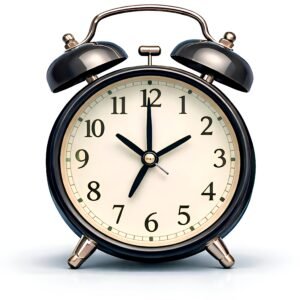
Use these category cards as broad navigation after the guide path above. For this hub, the most relevant product paths are alarm clocks, wall clocks, visible-time displays, vibrating wake-up options, bedside clocks, and travel/atomic clocks. Decorative categories can stay for site navigation, but do not present them as primary wake-up solutions unless the category page itself supports that use case.

Top Of The Best Modern Clocks