
Which Atomic Travel Alarm Clock Should You Pick?
An atomic travel alarm clock is only useful if it is both travel-friendly and easy to set manually when WWVB reception is poor. Auto-sync is helpful in the United States, but hotel rooms, interior walls, basements, metal structures, and trips outside WWVB coverage can make reception unreliable.
For travel, the priority order is compact size, battery operation, clear time-zone controls, manual-set fallback, readable backlight, and alarm reliability. A desktop atomic clock should not outrank a true travel clock unless it clearly fits in a bag and works well away from a desk.
Side-by-Side Comparison
Atomic Travel Alarm Clocks


Open the full side-by-side comparisonSee the full criteria table for all top picks when you need the extra detail.Show detailsHide details
Atomic Travel Clock Reality Check
Atomic clocks are often marketed as "always accurate," but travel use is messier. WWVB synchronization is a strong feature in the U.S., yet reception can depend on location, building materials, and time of day. A travel clock still needs normal alarm-clock basics: a readable display, reliable alarm, battery power, and a manual time-setting path.
| Travel check | Why it matters | Ranking rule |
|---|---|---|
| True travel size | A desk atomic clock may be accurate but awkward in luggage. | Demote desktop models unless the product is compact and battery-friendly. |
| Manual fallback | Auto-sync may fail in hotels or outside WWVB coverage. | Every recommended product should allow manual time setting. |
| Time-zone setup | Travel often means crossing zones. | Prefer clear zone buttons or menus over hidden setup steps. |
| Backlight behavior | Constant backlights drain batteries; no backlight is poor at night. | Prefer short-touch backlights or controlled illumination. |
| Battery type | Travelers need easy replacements. | AA/AAA or clearly specified battery is easier than obscure cells. |
Top 10 Of The Best Atomic Travel Alarm Clocks

Loud Radio Alarm Clock for Heavy Sleepers Adults,Easy to use,Bedside Digital Small Clock with Sleep...
Overview
The joujong bedside radio clock is a compact digital model with adjustable display brightness, a loud alarm, snooze, FM reception, and a sleep timer. It can use outlet or rechargeable-battery power.
Key Features
- The stated format combines size 4.72"W x 3.35"H, a Digital display, and Black coloring.
- Power and placement show power is listed as Corded Electric, Battery Powered, and intended use is Indoor, Outdoor.
- The FM section includes a retractable antenna, headphone jack, USB charging port, and wake-to-radio operation rated at up to 95 dB.
Considerations
Nothing in the title, description, or feature table identifies atomic or radio-controlled time synchronization, so this is outside the page's core requirement. Before considering it as a portable radio, confirm whether rechargeable batteries are supplied, their runtime, and which clock, alarm, radio, and USB functions remain available away from an outlet.

Emerson SmartSet Dual Alarm Clock Radio with AM/FM Radio, Dimmer, Sleep Timer and .9" LED Display, CKS1900
Overview
Emerson's CKS1900 is a corded digital AM/FM clock radio with a jade-green LED display, dual alarms, snooze, a sleep-to-music timer, and four dimmer levels. SmartSet restores calendar and time information after an interruption.
Key Features
- Room-fit data lists size 2.88"W x 5.25"H, a Digital display, and Black coloring.
- Operating requirements state power is listed as Corded Electric, the battery requirement is one CR2 battery is required and listed as included, and battery inclusion is Yes.
- Alarm schedules can be assigned to weekdays, weekends, or all seven days, with either radio or buzzer selected as the wake source.
Considerations
SmartSet is not described as WWVB, DCF, or an atomic receiver, so it should not be chosen for destination-based radio synchronization. The description and feature table publish different exterior measurements. Resolve the footprint, CR2 battery role, radio tuning region, and behavior during a power loss before packing it for travel.

uscce Digital Dual Alarm Clock Radio - 0-100% Dimmer with Weekday/Weekend Mode, 6 Sounds Adjustable Volume,...
Overview
The uscce dual-alarm radio clock centers on a fully dimmable LCD, separate weekday or weekend schedules, selectable tones or FM radio, a thermometer, headphone listening, and two USB charging ports.
Key Features
- Case details cover size 4.25"W x 2.56"H, a LCD display, and Black coloring.
- Installation facts are that power is listed as Corded-Electric, Battery, battery inclusion is No, and placement is Tabletop.
- Three AAA cells preserve time, settings, alarms, and radio during an outage, but USB charging stops and the description limits battery use to backup.
Considerations
No atomic receiver or automatic travel-zone setting is documented. This is primarily an AC bedside radio rather than a battery travel clock, and the backup cells are explicitly unsuitable for everyday operation. Check the destination outlet, bedside footprint, radio band, alarm volume range, and whether the headphone and charging cables needed for the trip are packed separately.
MainStays Black Atomic Digital Calendar Desk Alarm Clock with Temperature, W88631
Overview
MainStays W88631 is a battery-powered digital desk alarm that receives the U.S. WWVB time signal. It displays the date and room temperature and supplies a crescendo alarm with snooze.
Key Features
- The supplied details identify a black digital calendar desk clock but do not give complete dimensions, weight, or case material.
- Three AAA batteries are required and sold separately; tabletop use and the WWVB antenna direction are described.
- Seven factory time zones run from Atlantic through Hawaiian, while automatic daylight-saving adjustment and a low-battery indicator support routine setup.
Considerations
WWVB reception depends on location and signal conditions, so automatic setup is not assured at every destination or outside the supported zones. Confirm the clock's dimensions, luggage protection, button lock, backlight behavior, and manual-setting fallback. Travelers who need a European DCF receiver or an outlet-powered radio should choose a different item rather than assuming those functions.

Braun Digital Radio Controlled Travel Alarm Clock For Central European Time Zone (DCF) with Snooze, Compact...
Overview
Braun BC08G is a compact radio-controlled digital travel alarm intended for the Central European DCF time zone. Its negative LCD supports twelve- or twenty-four-hour time and a manually activated backlight.
Key Features
- The published case notation is W5.8cm x H5.8cm x D2.0cm, and the clock is supplied in grey with a negative LCD.
- One AAA battery is required but not included; the box description names the clock and instruction manual.
- The snooze interval is five minutes, the backlight remains on for ten seconds, and the crescendo beep is the documented alarm sound.
Considerations
DCF compatibility is the decisive limit: this is not presented as a North American WWVB clock. Confirm reception at the actual destination and whether manual time setting remains available when the signal cannot be received. Also verify luggage protection for the exposed controls and whether a negative display is readable enough without repeatedly using the short backlight.

Small Atomic Travel Alarm Clock with Auto/8S Backlight, 2 Alarm Settings, Temper
Overview
This marketplace item is described only as a small battery-operated atomic travel alarm with two alarm settings, temperature, and a choice between automatic or eight-second backlighting.
Key Features
- The title identifies a small digital bedside or travel form, while exact dimensions, weight, material, and manufacturer remain unstated.
- Battery operation is named, yet the required battery type, quantity, inclusion, and expected runtime are all omitted.
- Its alarm is said to rise gradually and continue beeping for two minutes, but no separate volume levels or snooze interval are provided.
Considerations
The signal standard, supported time zones, model number, controls, and manual-setting procedure are absent. Defer purchase until the merchant confirms whether it receives WWVB, DCF, or another regional signal and supplies the battery specification. Those omissions prevent a reliable decision about destination compatibility, replacement cells, luggage fit, or operation when automatic reception fails.
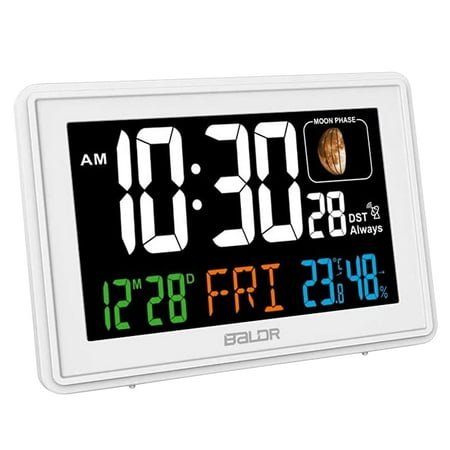
BALDR Atomic Alarm Clock - Large Color Display Digital Desk Clock (White)
Overview
BALDR's white desk clock combines atomic RCC reception with a large color-backlit digital display. Time, day, temperature, humidity, and moon-phase information are named in the description.
Key Features
- The description confirms a large white digital desk clock but omits full dimensions, item weight, case material, and button layout.
- Power method, battery type, battery inclusion, adapter contents, and backup behavior are not supplied in the available details.
- The color display is intended for desk use in a bedroom or office, with atomic reception handling initial setup and continued time correction.
Considerations
RCC alone does not identify the regional transmitter or supported time zones. Defer purchase until BALDR or the merchant confirms the signal standard, destination coverage, power requirements, display brightness controls, alarm and snooze behavior, and manual fallback. Without those points, the clock cannot be judged confidently for travel, bedside darkness, or replacement-power planning.

Geevon Atomic Alarm Clock for Heavy Sleepers – Mini Digital Clock with Snooze, 10s Backlight, Temperature,...
Overview
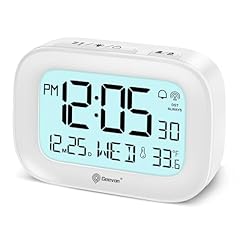
Geevon's mini atomic alarm receives WWVB and is designed for portable tabletop use. It combines a digital time display with indoor temperature, a short backlight, a crescendo alarm, snooze, and a travel lock.
Key Features
- Appearance and scale use size 3.54×2.36×1.06 inch, and White coloring.
- Two AAA batteries operate the clock and are not included, leaving it independent of a travel outlet.
- The case is 3.54 by 2.36 by 1.06 inches; the backlight lasts ten seconds, and the snooze adds five minutes.
Considerations
WWVB synchronization is appropriate only where that U.S. signal and the selectable zone cover the destination. Confirm the supported zone list, manual-set option, alarm loudness, and whether the lock disables every exposed control. The brief backlight avoids a continuous glow, but readers who need an always-lit display should rule this model out.
- Why it fits: This is the core match for the page because it is small, battery-powered, and framed around atomic travel use.
- Check before buying: Verify WWVB sync, manual time setting, time-zone controls, alarm count, and backlight duration.
- Best for: U.S. travelers who want auto-set time but still need manual fallback.
- Limit: Do not promise sync in every hotel room.

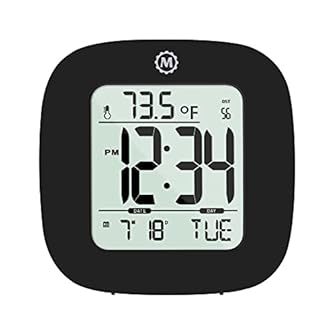
Atomic Desk Clock by Marathon - Blue
Overview
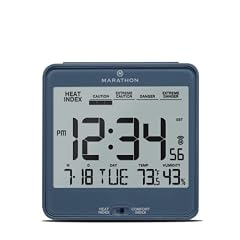
Marathon CL030054BL is a blue digital atomic desk clock with a progressive alarm and a large snooze control. It is presented as a battery-powered tabletop model for indoor office use.
Key Features
- The dimensional entry lists size 3.74"W x 3.74"H, a Digital display, and Blue coloring.
- Power access requires that power is listed as Battery Powered, the battery requirement is 2 AA batteries required. (included), and battery inclusion is Yes.
- Two AA batteries are required and included, while the square body is listed at 3.74 inches wide by 3.74 inches high.
Considerations
The available specifications do not identify the received signal, supported time zones, daylight-saving controls, backlight, or manual-setting fallback. Defer purchase for international travel or a specific atomic region until those functions are confirmed. Also check case depth and control lock because neither luggage profile nor protection against accidental button presses is documented.
- Why it fits: A Marathon desk clock may be credible as an accurate compact display, but the card must justify travel fit.
- Check before buying: Confirm dimensions, battery operation, manual setting, and travel durability.
- Best for: Travelers who value display clarity over minimal size.
- Limit: Desk-clock positioning conflicts with travel intent.

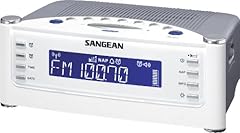
Sangean RCR-22 Atomic Clock with FM-RDS / AM / Aux-in Digital Tuning Clock Radio, silver, one size
Overview
Sangean RCR-22 is an AC clock radio with DCF or WWVB-controlled time, AM/FM digital tuning, an adjustable LCD backlight, two alarms, snooze, and sleep and nap timers.
Key Features
- Measured profile details are size 6 x 7.5 x 3 inches, and weight 2.07 pounds.
- Power source type is AC; the U.S. version is 120V 60 Hz and the European version is 230V 50 Hz.
- Fourteen station memories cover seven FM and seven AM presets; a supercapacitor retains alarm and station settings for up to one hour during an interruption.
Considerations
At 2.07 pounds and with region-specific AC versions, this is a transportable bedside radio rather than a small travel alarm. Match the exact voltage version, plug, broadcast bands, and atomic-signal setting to the destination. The supercapacitor protects memories briefly; it is not evidence that the display, radio, or alarms continue normally through a long outage.
Which products actually provide atomic or radio-controlled time?
MainStays names WWVB reception, Braun BC08G names Central European DCF, Geevon names WWVB, and Sangean lists DCF or WWVB versions. Marathon is labeled atomic, while BALDR and the unbranded marketplace clock use broader RCC or atomic wording without enough regional detail. The joujong, Emerson, and uscce radios do not identify any atomic receiver. Start with the destination's transmitter and supported time zone; a clock that merely restores stored time after an outage is not equivalent to radio synchronization.
Which power arrangement is practical away from home?
Geevon uses two AAA cells, MainStays uses three AAA cells, Braun uses one AAA cell, and Marathon includes two AA cells. The unbranded atomic clock says battery operated but omits the battery specification, while BALDR omits power details entirely. Joujong allows outlet or rechargeable-battery power, but its included battery status and portable runtime need confirmation. Emerson, uscce, and Sangean are primarily corded. Treat backup cells or a short-memory supercapacitor as outage protection unless normal untethered operation is explicitly stated.
How do the alarms, radios, and displays differ at night?
The radio models offer the deepest wake controls: Emerson supports schedule-based dual alarms, uscce adds selectable tones and FM, and Sangean supplies two alarms plus sleep and nap timers. MainStays, Braun, Geevon, and the sparse atomic item use crescendo or gradually increasing beeps. Display behavior also varies: uscce can dim to zero, Braun and Geevon use brief manual backlights, and BALDR uses a color backlit screen without documented brightness controls. Match sound, snooze, and nighttime light to the room rather than the travel label.
What should be confirmed before relying on one during a trip?
Verify signal standard, destination coverage, time-zone list, daylight-saving override, manual-setting fallback, battery type, and whether batteries are included. For corded radios, match voltage, plug, and radio bands; for battery clocks, check runtime and carry spare cells. A travel lock matters when buttons face the luggage contents, yet only Geevon documents one. Sparse BALDR and marketplace details justify postponing the order before departure. Reject any non-atomic radio clock when automatic signal correction is a mandatory requirement rather than a preference.
Related Clock Guides



Best Fit by Travel Situation
| Travel situation | Choose | Avoid |
|---|---|---|
| Domestic U.S. travel | Atomic clock with manual time-zone control | Clock that assumes automatic sync will always work |
| Hotel room | Compact clock with short backlight and ascending alarm | Bright always-on display that lights the room |
| Carry-on packing | Protected folding or covered display | Exposed buttons that can be pressed in a bag |
| Guest room use at home | Atomic desk/travel hybrid with large display | Ultra-small clock that guests struggle to set |
| International travel | Manual-set travel alarm clock | Buying atomic sync as the main reason; WWVB sync is North America-centered |
When an Atomic Travel Clock Is the Wrong Choice
Skip the atomic feature if you often travel outside North America, sleep in hotels with poor radio reception, or want the smallest possible clock. In those cases, a simple manual travel alarm with protected buttons may be more dependable.
Also check product dimensions carefully. A clock can be accurate and useful on a nightstand but still be a poor travel pick if it has no cover, no button protection, or a body that takes up too much bag space.