


Key specs
Technical terms that matter for clocks
- Voltage
Nominal voltage is the cell’s open-circuit voltage — about 1.5 V for alkalines, ~1.2 V for NiMH. Clocks tolerate a range, but mechanisms can misstep if voltage sags unpredictably, so stable voltage under load helps reliable timekeeping.
- mAh (capacity)
Milliampere-hours (mAh) measures stored charge and predicts runtime. Clocks draw tiny steady currents, so even low-capacity cells can last months; higher mAh means longer service between swaps.
- Internal resistance
Internal resistance causes voltage sag during pulses; low resistance delivers peak current cleanly and reduces missteps in stepper-driven clocks. It’s often more important than raw mAh for motors.
- Self-discharge / LSD
Self-discharge rate shows how fast a cell loses charge in storage; low‑self‑discharge (LSD) NiMH retain most charge for months, making them well-suited to clocks left unattended. See lithium vs rechargeable discussion for chemistry trade-offs.
- Pulse current
Pulse-current rating describes brief high-current demands; clocks with second hands need batteries that tolerate short peaks without voltage collapse, which ties back to low internal resistance rather than capacity alone.
Voltage tolerance Recognize sensitive movements, common symptoms, and a quick pre-swap test
Which clocks tolerate 1.2V rechargeables (and which don't)
Which clock types accept 1.2V cells
Most quartz movements found in wall clocks and simple mantel clocks run reliably on 1.2V NiMH cells because they draw only microamps and the movement tolerates the slightly lower voltage. Basic analog alarm clocks with a simple quartz motor also usually tolerate 1.2V.
Clocks that are often sensitive include:
- Digital clocks with LED/LCD displays or backlights (display brightness or logic can need 1.5V).
- Clocks with solenoids, chimes, cuckoos, or large gear motors (these need higher instantaneous voltage for reliable pulses).
- Older movements or devices with voltage-dependent reset circuits.
Consult the manual or the broader guide on what battery does a clock use when in doubt.
Observable signs of under-voltage and a quick check
Common symptoms of insufficient voltage:
- slow or irregular second-hand motion
- intermittent stopping or failing to chime
- dim or flickering display
Simple pre-swap check (fast, no special tools):
- Insert a fresh, fully charged NiMH cell and observe for 5–10 minutes.
- Watch the second hand for steady ticks and the display/backlight for full brightness.
- If problems persist, try a fresh alkaline temporarily; if it fixes the issue, the clock is voltage-sensitive and may prefer 1.5V cells or an external adapter.
When uncertainty remains, use low self-discharge NiMH cells for best chance of compatibility.
Myths
Common myths about using rechargeable batteries in clocks
Most modern quartz movements run fine on 1.2V; only heavy‑torque or legacy synchronous motors need 1.5V.
The small nominal voltage gap is less important than motor current draw and internal resistance under load.
NiMH batteries are far less prone to leakage than old or exhausted single‑use alkalines.
Different chemistry and better seal behavior mean leaks usually come from aged disposable cells, not fresh NiMH.
For low‑drain clocks, low self‑discharge and low internal resistance matter more than very high mAh numbers.
Clocks draw microamps; cells with low self‑discharge keep time longer between charges than high‑mAh but leaky cells.
Buying checklist
Prioritized checklist for clock batteries
- Physical size and fitConfirm the exact cell size and how it sits in the compartment—AA, AAA, slim AA or button cells differ. A snug, correct-sized cell prevents intermittent contact and extra current draw from vibration.Look forCorrect cell size and firm fit in the compartmentAvoidForcing oversized cells or using loosely rattling cells
- Chemistry: choose LSD NiMHLow‑self‑discharge NiMH keeps usable charge for months and holds ~1.2V under light clock loads, making it the best practical chemistry for clocks. For how rechargeables compare to alkalines on longevity, see rechargeable vs longest-lasting options.Look forLabels saying 'LSD', 'low self‑discharge' or 'precharged NiMH'AvoidGeneric NiMH or alkaline-labeled cells marketed for long shelf life without LSD claims
- Capacity vs internal resistanceBalance mAh rating with low internal resistance (IR); very high‑mAh cells sometimes have higher IR and worse transient voltage. Prefer midrange capacities with published IR or 'low IR' claims for clocks that pulse (alarms, backlights).Look formAh plus internal resistance or 'low internal resistance' specAvoidChoosing solely on highest mAh when IR is not specified
- Pre‑charged status, charger compatibility, and trustworthy claimsBuy 'ready‑to‑use' precharged cells and confirm any charger is NiMH‑compatible (smart chargers with delta‑V or timed modes are safest). Trust concrete specs like LSD, cycle life and IR; ignore vague buzzwords such as 'always ready' or unsupported ultra‑high performance claims.Look forPrecharged cells and a NiMH‑specific charger with safety featuresAvoidUnclear marketing terms and chargers that don't state supported chemistries
Pack picks Practical recommendations based on common clock scenarios
Which rechargeable pack to choose by clock type
Wall and desk clocks
For mains-adjacent wall clocks and simple desk clocks, priority goes to low self-discharge (LSD) NiMH cells with moderate capacity (1500–2500 mAh). These hold charge on the hanger or shelf for months and usually tolerate the lower 1.2 V of rechargeables. Look for pre-charged packs if long shelf-life is needed.
Small alarm clocks and travel clocks
Choose compact, pre-charged LSD NiMH or single-use alkalines depending on runtime needs. Pre-charged LSD cells arrive ready and are safer for travel storage; they also avoid the inconvenience of carrying a charger. For intermittent alarms, capacity can be lower if the clock draws only micro‑currents.
Antique clocks and heavy-torque movements
Mechanical or high-torque battery movements demand cells with the lowest internal resistance and the highest usable current. Prefer high-capacity NiMH with explicit low internal resistance specs or stay with fresh high-drain alkalines if the clock shows signs of under‑voltage (sluggish hands, stopped chiming). When in doubt, test with an actual movement before committing to a full swap.
Features to prefer:
- LSD NiMH chemistry (holds ~70–80% after a year)
- Pre-charged packs for shelf life and travel
- Explicit cycle-life and low internal resistance claims for torque-heavy devices
Features to avoid:
- Packs with unclear chemistry or no LSD claim
- Mixing rechargeables with alkalines in the same device
Quick tip: record install dates on cells; replace as a matched set when performance drops.
Good all‑round wall and desk clock cells
Overview: 8 AA NiMH cells, 2000 mAh, advertised as low self-discharge and arriving pre‑charged. The manufacturer cites up to 1,000 recharge cycles and retention of about 80% capacity after two years.
Why it fits clocks: Pre‑charged LSD chemistry keeps wall and desk clocks running reliably without a charger on hand. Capacity is a balanced middle ground—better than low-capacity cells for occasional higher draws, yet not oversized for small housings.
Caveats: Runtime at 1.2 V may read shorter than 1.5 V alkalines in sensitive movements; check fit since NiMH can be slightly larger. For high‑torque or vintage movements, consider cells that explicitly list low internal resistance.
Chips: [“LSD NiMH”, “Pre-charged”, “2000 mAh”]
CTA: View pack details
Power care How to charge, store, and keep clocks safe
Chargers, charging protocol, and storage
Charger types explained
- Basic (dumb) chargers: simple constant-current units that stop only by timer or manual removal. Cheap and fine for occasional top-ups but risk overcharging if left in too long.
- Smart chargers (-ΔV / multi-stage): detect full charge by voltage or temperature and switch to trickle or stop. Prefer for NiMH cells used in clocks—they protect capacity and longevity.
- Individual-bay chargers: charge each cell independently so mixed-state packs can be charged safely.
- USB / travel chargers: convenient but check current; many are lower current and slow-charge safely, which is acceptable for storage or gentle top-ups.
Practical charging and storage protocol
- Inspect cells for damage and match size/chemistry before charging.
- Use a smart charger with -ΔV detection or an intelligent trickle mode. Aim for ~0.1C (C = cell capacity) for long life; higher currents ok for occasional quick fills.
- Charge cells individually or in matched sets; never mix chemistries or wildly different capacities in the same device.
- For medium-term storage (weeks–months), keep NiMH cells cool and partially charged. LSD NiMH can be stored charged; otherwise ~40–60% charge reduces stress and self-discharge.
- Label cells with date and role (clock, spare) and rotate spares into service to avoid long undisturbed storage.
- Let cells cool before use after charging.
A compact, labeled organizer helps; see the battery organizer recommendations for options.
Never mix alkaline or Li-ion with NiMH in the same device. Avoid charging damaged or leaking cells. Use chargers with short‑circuit and overheat protection and never leave high-current charging unattended for long periods.
Good all‑round smart charger and cells
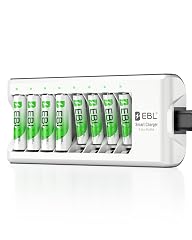
Includes 4 AA (2800mAh) and 4 AAA (1100mAh) NiMH cells and an upgraded 8‑bay charger. Features -ΔV cut‑off, trickle charge, per‑bay LED indicators, and basic safety protections (short‑circuit, heat detection). Charges AA/AAA individually and supports flexible bay counts.
Test & care
How to test and maintain clock cells
Fast voltage check — what to measure?
Use a digital multimeter to read the cell’s resting voltage. For NiMH expect about 1.2–1.3 V when charged; anything under ~1.0 V at rest usually indicates replacement is needed.
Simple capacity or load test at home?
Apply a small, steady load (a resistor or a low-power bulb) and watch voltage for 10–30 minutes; healthy cells hold voltage with little sag. Large voltage drops under light load mean high internal resistance or lost capacity.
What are common signs a cell is failing?
Look for rapid voltage sag under load, intermittent clock movement, bulging/swelling, corrosion, or visible leakage. Also watch for fast self-discharge—cells that die days after charging are unreliable.
Everyday maintenance routines?
Clean battery contacts with a cotton swab and isopropyl alcohol, avoid abrasive scraping, and dry fully before reinserting cells. Label packs with install date and capacity, rotate spares, store cells cool and partially charged, and never mix old and new cells.
Quick troubleshooting tips?
If a clock stops after swapping cells check polarity and contact springs first, then measure cell voltage. Slow or jerky movement usually points to under-voltage or high internal resistance; persistent drain suggests a movement fault or short.
How recommendations were tested
Recommendations were evaluated with simulated low‑drain clock runs, short‑term loaded voltage checks, and multi‑week self‑discharge observations to match real use.
- Simulated low‑drain runtime
Cells were placed on a 100–500 µA load to mimic quartz movements; runtime and terminal voltage were logged to identify when clocks would begin to slow.
- Loaded voltage and recovery
Short bursts with a 10–50 mA load measured voltage sag and rebound, revealing internal resistance that can cause intermittent ticks despite healthy open‑circuit voltages.
- Self‑discharge soak and limitations
Cells were stored at room temperature for 4–12 weeks with periodic OCV checks to observe real decay. Small sample sizes and household gear limit precision; methods are given so readers can repeat basic checks.
Decision checklist
Quick checklist and two tests
- Movement tolerates 1.2 V cells
- Clock keeps time during a brief NiMH run
- Prefer LSD NiMH chemistry (low self‑discharge)
Quick decision: if the clock’s movement accepts 1.2 V, keeps accurate time with a charged LSD NiMH, and shows no voltage‑sag under brief load, rechargeables are a good fit.
Two simple tests: Step 1: Swap a freshly charged LSD NiMH and observe timekeeping for 72 hours for lag or drift. Step 2: Measure resting voltage, then apply a 100–200 Ω short load for 10–30 seconds to check for excessive voltage drop.