

Side-by-Side Comparison
Weather Atomic Clocks


Open the full side-by-side comparisonSee the full criteria table for all top picks when you need the extra detail.Show detailsHide details
Top 10 Of The Best Weather Atomic Clocks

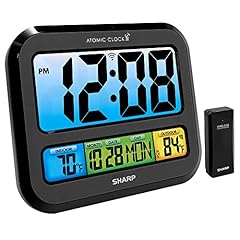
Sharp Atomic Clock with Bright Color Display, Atomic Accuracy, Jumbo 3" Easy to Read Numbers -...
Overview
This Sharp color-display atomic clock measures about 8.75 × 7.9 inches and can hang on a wall or stand on a desk. Three-inch time digits share the screen with calendar and temperature data.
Key Features
- WWVB reception updates time automatically and supports daily synchronization.
- An included wireless sensor reports outdoor temperature from up to 100 feet away.
- Plug-in power keeps the color backlight on continuously.
Considerations
Battery mode needs three AA cells in the clock and two AAA cells in the sensor, none included; its backlight then lasts five seconds per press. The source does not say whether a power adapter is included, so confirm package contents.

Sharp Atomic Clock - Never Needs Setting! - Jumbo 3" Easy to Read Numbers - Indoor/Outdoor Temperature...
Overview
This gloss-black Sharp atomic clock uses a large monochrome LCD with three-inch time digits. It can be wall mounted or used on a desk with its integrated stand and shows calendar information.
Key Features
- WWVB reception automatically synchronizes the displayed time with daily updates.
- An included outdoor sensor transmits temperature from up to 100 feet away.
- The display also reports indoor temperature, date, and day of week.
Considerations
The main unit needs three AA batteries and the sensor needs two AAA batteries; none are included. No backlight, humidity reading, weather forecast, alarm, physical clock dimensions, or sensor weather rating is documented in the available description. Confirm those limitations before choosing it.
LFF Atomic Clock, Digital Wall Clock with Indoor & Outdoor Temperature, Date, Time, Alarm Clock. Atomic...
Overview
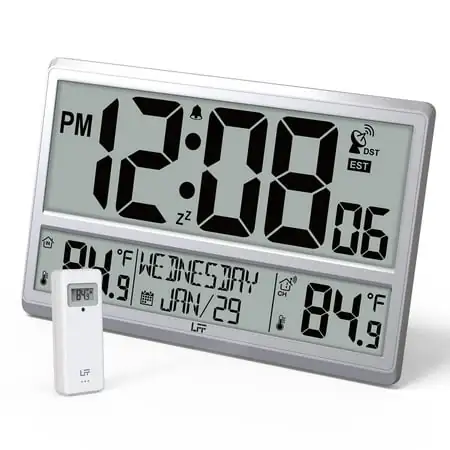
The LFF is a large 14.2 × 9.4 × 1.1-inch digital atomic clock with time digits up to 4.5 inches tall. It can be wall mounted or freestanding for viewing across a room.
Key Features
- WWVB synchronization updates time, date, and calendar information.
- Daylight saving time can update automatically or be switched off.
- An included outdoor sensor has a stated open-range reception distance up to 328 feet.
Considerations
The package is listed with clock, sensor, and manual, but the power source, battery types, battery inclusion, backlight, and humidity support are not given. Confirm all power requirements and whether the selected display remains readable in low light.

BALDR Indoor Outdoor Thermometer Wireless with Atomic Clock, Weather Stations Wireless Indoor Outdoor for...
Overview
This BALDR is a compact atomic weather station with a 4.5-inch display for desk or wall placement. It tracks indoor and outdoor temperature and humidity rather than temperature alone.
Key Features
- WWVB time correction and automatic DST adjustment are provided.
- One remote sensor is included, with support for three sensor zones.
- It records 24-hour highs and lows and adds forecast, alarm, snooze, calendar, and trends.
Considerations
The station needs two AAA batteries and the sensor needs two AA batteries; none are included. Its backlight stays on for 20 seconds per press, not continuously. Two extra sensors require separate purchase, and forecast methodology is not detailed.
Projection Alarm Clock with Weather Station, Atomic Digital Alarm Clock with Projection on Ceiling,Indoor...
Overview
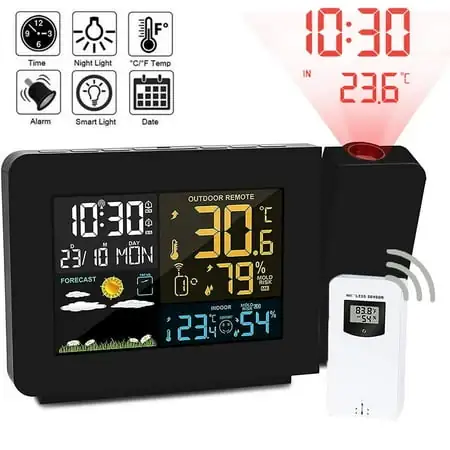
This projection weather alarm clock displays time and alternating indoor or outdoor temperature on a ceiling or wall. It also monitors humidity and pressure and forecasts conditions for the next eight hours.
Key Features
- The package lists a weather clock, power adapter, outdoor sensor, and instructions.
- Its sensor has a 60-meter radio range and an IPX4 rating.
- High and low temperature, frost, dew point, comfort, and mildew-risk alerts are included.
Considerations
The seller explicitly states that this is not an atomic clock; time must be set manually. Buyers requiring WWVB synchronization should reject it. The listing also omits backup-battery details, projection distance, alarm schedule, and adapter electrical specification.
Also featured in: Best Ambient Weather Radio Controlled Projection Alarm Clocks, Best Projection Weather Alarm Clocks, Best Projection Clocks With Outdoor Temperature, Best Oregon Scientific Atomic Projection Clocks, Best Digital Weather Station Alarm Clocks, Best Weather Projection Alarm Clocks, Best Weather Monitor Alarm Clocks, Best Projection Alarm Clocks With Temperature, Best Oregon Scientific Projection Alarm Clocks

Weather Station Indoor Outdoor Thermometer Wireless with Multiple Sensors, VA Color Display Atomic Clock,...
Overview
This SZFZMZ station uses a 7.5-inch VA color display and three outdoor sensors to monitor four locations. It combines atomic time with temperature, humidity, pressure, and a 12-hour forecast.
Key Features
- WWVB reception supports seven listed U.S. time-zone settings.
- Three included sensors transmit up to 200 feet in an open area.
- Dual alarms, max/min records, alerts, moon and tide data, comfort icons, and four brightness levels are listed.

Considerations
A DC adapter is included; battery operation is supported but batteries and their required types are not specified. On batteries the display lights for only 15 seconds. The backlight turns off during WWVB reception, and sensor readings have stated tolerances.

KETOTEK Digital Projection Alarm Clock for Bedroom Ceiling Wall LA LCD Display Radio Controlled Weather...
Overview
The KETOTEK combines a VA color weather display with WWVB-controlled time and a rotating projection of time plus temperature. It is intended for a bedroom ceiling or wall projection setup.
Key Features
- Projection rotates 180 degrees and alternates indoor and channel-one temperature.
- Three remote sensors provide temperature and humidity data from four locations.
- Two alarms support weekday, weekend, or full-week cycles with 1–30-minute snooze.

Considerations
The description does not clearly state the main-unit dimensions, power arrangement, adapter inclusion, sensor battery types, or projection distance. Confirm that all three sensors are included with this exact model and verify how the automatic light sensor behaves in the bedroom.

Weather Station Wireless Indoor Outdoor, Thermometer Wireless with Remote Sensor, Home Weather Station,...
Overview
This Brataste station has a 7.5-inch color screen showing time, date, indoor and outdoor climate data, pressure, moon phase, alarms, and a forecast. It can stand on a table or mount on a wall.
Key Features
- Atomic time and date operate alongside dual alarms and snooze.
- One sensor is included; the station supports three channels over 200 feet in open space.
- An adapter enables permanent display, five brightness levels, night mode, and a USB charging port.

Considerations
Extra sensors are separate purchases. Batteries preserve settings during an outage, but the listing omits battery types, battery inclusion, adapter inclusion, and USB output; confirm these setup details before use. Forecast wording varies between 8–24 and 12–24 hours, so treat it as trend guidance.
Projection Alarm Clock Weather Station, Protmex PT3391 WWVB Radio Controlled Clock Weather Monitor...
Overview
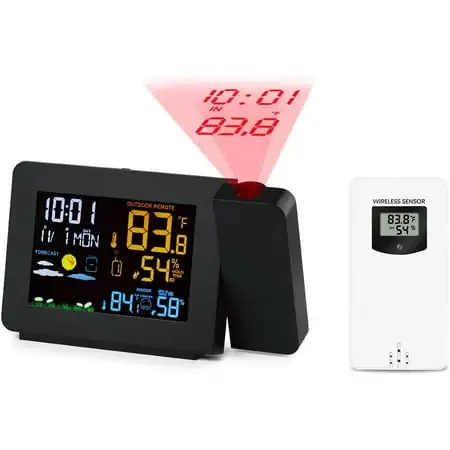
The Protmex PT3391 is a WWVB projection alarm clock and weather monitor. It projects time and temperature from 3.3 to 10 feet while displaying indoor and outdoor temperature, humidity, and forecast information.
Key Features
- Two alarms support weekday, weekend, or everyday schedules with adjustable 5–60-minute snooze.
- One IPX4 remote sensor is included, with support for three channels up to 200 feet.
- Four screen-brightness levels and two projection levels support bedroom use.
Considerations
The station uses 5V DC power with a CR2032 battery reference, while the sensor needs two AA cells; inclusion is not fully clear. Keep the sensor out of direct rain despite IPX4 wording, and confirm the exact adapter and backup-cell contents.
Also featured in: Best Ambient Weather Radio Controlled Projection Alarm Clocks, Best Atomic Projection Clocks, Best Multi Function Digital Weather Projection Alarm Clocks, Best Weather Station Dual Alarm Clocks, Best Digital Weather Station Alarm Clocks, Best Weather Projection Alarm Clocks, Best Weather Monitor Alarm Clocks, Best Oregon Scientific Projection Alarm Clocks

MeesMeek Weather Station Wireless-Indoor Outdoor Thermometer Temperature Monitor,Hygrometer Humidity Sensor...
Overview
This MeesMeek station uses a 6.69-inch LCD for atomic time, calendar, indoor and outdoor climate data, pressure, and moon-phase information. It is designed for a larger, wide-angle digital readout.
Key Features
- WWVB reception supports PST, CST, and EST with automatic DST and manual fallback.
- One sensor is included, with three channels available for separately purchased sensors.
- Dual alarms, seven-minute snooze, high/low temperature alerts, and automatic backlight control are listed.

Considerations
The seller specifically says WWVB operation does not work in Wisconsin, an unusual limitation that should be verified before purchase. Adapter and battery modes are described, but battery types and inclusions are absent. Confirm supported time zones and sensor range.
Also featured in: Best Thermometer And Hygrometer Clocks, Best Moon Phase Weather Atomic Clocks
Where will the display and sensors be placed?
Choose between a wall-or-desk clock, a compact bedside station, and a projection model. Check digit height as well as screen size: the LFF offers 4.5-inch digits, while several color stations pack more data into 6.69- or 7.5-inch screens. Wireless ranges are measured in open space and shrink through walls or metal obstacles. Put the outdoor sensor in a shaded, ventilated location within its protection limits, and ensure the main unit has a clear viewing angle, practical battery access, and access to controls.
How do adapter and battery modes change the display?
Plug-in operation usually enables a continuously lit color screen, while battery mode often limits illumination to 5, 15, or 20 seconds. Sensors require their own AA or AAA cells, generally excluded. Some stations use batteries only to preserve settings during an outage, and several listings omit cell types or adapter inclusion. Plan an outlet for always-on backlight or projection, then verify every required battery for the base and each sensor. Pair channels one at a time and allow WWVB reception overnight.
Which functions are useful, and which model is not atomic?
Basic Sharp and LFF clocks focus on time, calendar, and temperature. Weather stations add humidity, max/min records, pressure-based forecasts, alerts, moon phase, and sometimes multiple zones. Projection models suit bedside viewing but require confirmed range, rotation, and dimming. The Foryou projection clock is explicitly not atomic and needs manual time setting, so it should be removed from any WWVB-only shortlist. Also reject single-sensor units if three rooms must be monitored immediately and extra sensors are unavailable or unsupported.
What should be verified before relying on the readings?
Confirm WWVB time-zone support for the installation location, manual-time fallback, DST controls, sensor count in the box, radio range, weather rating, measurement ranges, and stated tolerances. Ask whether the adapter, backup cell, sensor batteries, and mounting hardware are included. Forecast icons are derived from local pressure or sensor trends and should not be treated as a full regional forecast. Resolve unusual limitations, such as the MeesMeek Wisconsin note, and check whether the backlight goes dark while the clock searches for WWVB.
Alternatives to Weather Atomic Clocks

Best Moon Phase Weather Atomic Clocks

Best Wireless Weather Station Atomic Clocks
Related Articles



Latest Review Posts

Hook for Hanging a Heavy Wall Clock: How to Choose Hardware That Actually Holds
Replacement AA Battery Holders for Clocks: Fit, Safety, and Affordable Options
Bulk AA Batteries for Clocks: Packs That Save Money Without Sacrificing Life

Should You Use Rechargeable Batteries For Clocks and Which Packs To Buy

Best Kids’ Alarm Clocks