- DS3231 accuracy typically ~±2 ppm (~0.17 s/day; ~5 s/month).
- AT24C32 provides 32‑Kbit (4 KB) EEPROM for small logs/config.


Buying criteria
Factors that actually determine which RTC keeps time best
Oscillator accuracy (ppm) defines baseline drift; a few ppm difference adds up to minutes per year. Match accuracy to the clock’s expected run time and correction schedule.
Temperature swings are a major source of time error; TCXOs or RTCs with internal compensation (like DS3231) hold time far better across ranges.
Backup type, socketed coin cell or supercap, and expected lifetime affect unattended operation and maintenance cadence.
On-board EEPROM is handy for storing settings or calibration constants but adds cost and complexity.
Address conflicts, required pull-ups, and bus speed limits matter in multi-device builds and long traces.
How the modules were evaluated
Evaluation combined manufacturers’ datasheet figures (ppm, aging, temperature coefficients), aggregated community field reports, short bench drift trials, and qualitative library/support checks. Results are presented as ranges and uncertainty intervals so readers can reproduce and judge.
- Datasheet metrics
Recorded nominal accuracy (ppm), long‑term aging, and TCXO/temperature compensation notes from datasheets; battery retention and AT24C32 EEPROM specs were noted to reflect real‑world behavior.
- Community field reports
Surveyed forum logs and GitHub issues for drift anecdotes and failure modes; reported medians and outliers rather than single values to capture variance across batches and environments.
- Drift trials and support checks
Short bench trials: modules synced to NTP, logged hourly for 7–14 days at stable room temperature to compute ms/day. Libraries and documentation were tested for example sketches, I2C address quirks, and maintainer responsiveness.
Simple reproduction: sync the RTC to NTP, run a sketch that logs the epoch hourly, keep temperature stable, and compare timestamps to compute ms/day.
Top pick
Accurate, feature‑rich RTC module for reliable Arduino clocks
High accuracy TCXO timekeeping
DS3231 + AT24C32 modules pair a temperature‑compensated oscillator with a modest EEPROM, making them ideal for projects that need rock‑steady timekeeping and local configuration storage. The on‑board battery input preserves time through power loss, and common breakout boards include standard 4‑pin I2C headers and through‑hole pins for easy mounting. Good fit for standalone clocks, dataloggers, and alarm clocks that operate without network time.
- TCXO gives far better long‑term accuracy than DS1307 variants
- AT24C32 EEPROM stores settings, logs, or calibration offsets
- Automatic battery backup maintains time when main power fails
- Wide voltage range and common pinout simplify wiring and replacement
- Higher unit cost and slightly larger footprint than simpler RTC boards
- Additional components (EEPROM, battery holder) increase BOM and assembly
- Marginally higher quiescent current than the lowest‑power RTCs
Reliable and versatile. The DS3231’s internal temperature compensation keeps drift low without external correction, while the AT24C32 EEPROM adds convenient local storage for settings or tiny logs. Backup switching to a coin cell preserves time across outages, and widely available breakouts make mounting straightforward. The trade‑offs are modestly higher cost and a larger module footprint compared with minimalist RTCs — worth it when accuracy and resilience matter.
Value DS3231 Kit
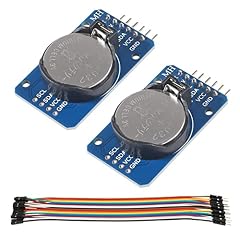
Pragmatic DS3231 AT24C32 Duo for Classroom and Bulk Builds
Battery-backed version included
A two-module DS3231 kit that pairs the chip’s temperature‑compensated timekeeping with an AT24C32 EEPROM and battery backup. Suited to classrooms, labs, and bulk prototyping where per‑unit cost and ease of use matter. Functionality mirrors higher‑priced DS3231 boards, but buyers should expect economy PCBs and simpler assembly compared with premium modules.
- Genuine DS3231 core: TCXO accuracy and temperature compensation
- Two‑pack lowers per‑module cost for multiple projects
- Onboard AT24C32 EEPROM for settings, logs, or calibration data
- 5V‑friendly I2C wiring and strong Arduino library support
- PCB and solder quality vary between sellers
- Coin‑cell holders and batteries may need replacement sooner
- Limited or no manufacturer warranty/support on many listings
- Occasional counterfeit or poorly marked components reported
Solid value for bulk projects. The DS3231 AT24C32 pair offers the same TCXO‑based accuracy as pricier modules plus EEPROM and battery backup, making it ideal for classrooms and multiple Arduino clocks. Long‑term reliability depends on PCB assembly and battery holders; a quick inspection and occasional rework improve longevity.
Budget DS3231SN
Budget DS3231SN module for prototyping
- DS3231 TCXO accuracy potential
- On-board AT24C32 EEPROM
- Wide 3.3–5.5V operating range
- Very affordable in multipacks
- Variable board assembly and soldering
- Occasional counterfeit or mislabelled parts
- Cheap battery holders or peripheral components
- Limited factory QA and calibration
Keeps the core DS3231 features and adds 32K EEPROM at a low price, but manufacturing and peripheral quality can vary. Recommended for experiments, classroom kits, and prototypes where testing and easy replacement are acceptable; avoid untested units in mission‑critical clocks.
Integration & tuning
Integrate, set and validate the RTC
- Wiring
Connect VCC to 3.3–5V (match board logic), GND to ground, SDA to Arduino SDA pin, SCL to SCL. Insert the backup coin cell with correct polarity and check module VCC jumper if present.
- Choose a library
Use a well‑maintained library such as Adafruit RTClib or a DS3231-specific library; install via Library Manager and run the I2C scanner to confirm address 0x68.
- Set and verify time
Run the example sketch to set time from compile time or a manual timestamp, then read and print time over Serial every minute for initial verification.
- 48–72 hour drift validation
Record timestamps at 0, 24, 48 (and 72) hours against an accurate reference (NTP or smartphone); compute seconds drift per day to characterize module behavior.
- Troubleshooting
If drift or failures appear, check battery voltage, solder joints, address conflicts, and swap libraries; use an oscilloscope or logic analyzer for I2C signal issues.
Backup cells drain over years and should be checked.
A weak cell can lose calendar data during power loss and cause resets; replace if voltage falls below spec.
Accuracy varies with component quality and board layout.
Poor soldering or noisy power rails can introduce small errors despite the same IC.
DS3231 compensates for temperature but some residual drift remains.
Long‑term aging and local thermal gradients can still cause offsets that benefit from measurement.
Check with an I2C scanner before blaming code. A detected 0x68 confirms hardware; if missing, recheck VCC, GND, SDA/SCL and battery polarity.
Conclusion
Choose, Verify, Mount: Final Decision Guide
- Precision: DS3231 AT24C32 I2C RTC Module — best-built DS3231 breakout for tight drift control.
- Value: DS3231 AT24C32 RTC Module with Battery Support — EEPROM plus battery backup for classroom and bulk projects.
- Budget: Teyleten DS3231SN — same DS3231 timing at lower cost, expect variable board quality and keep spares handy.
Match the module to the project goal. For highest precision, favor the top‑pick DS3231 breakout; for balanced value and reliable backup choose the battery‑support version; for prototyping the Teyleten board offers acceptable timing if replacement parts are acceptable.
Purchase and validate quickly: confirm a genuine DS3231, battery holder compatibility, and AT24C32 presence if EEPROM is needed; set time and run a 48–72 hour drift log against a reference. Mount using standoffs, isolate from motors/heaters, avoid direct sunlight, allow a 24‑hour thermal soak, and add light insulation or a shield to reduce temperature swings.