
Side-by-Side Comparison
Atomic Digital Desk Clocks
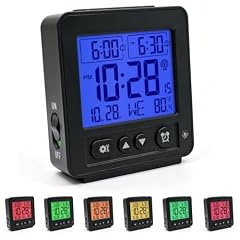
Open the comparison detailsCompare the criteria for the picks shown above.Show detailsHide details
Top 10 Of The Best Atomic Digital Desk Clocks
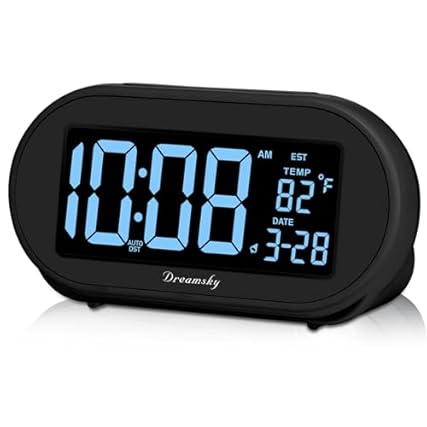
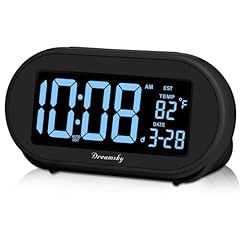
DreamSky Auto Set Alarm Clock for Bedroom, Digital Desk Clock with 0-100% Dimmable Brightness Dimmer, Auto...
Overview
DreamSky's DS305 is a plug-in auto-set alarm clock with a 4.3-inch LCD, date, temperature, and four United States time zones. Its display brightness adjusts continuously from off to full output.
Key Features
- Automatic daylight-saving option
- Ascending beep with eight-minute snooze
- One USB port accepts the included DC adapter; the second charges a phone or tablet
Considerations
Still, the seller says the clock loads the correct time when first plugged in, but does not claim WWVB or another radio-time receiver. An included CR2032 preserves time, date, and alarm settings during an outage; it cannot light the display or sound the alarm. Still, the supplied record gives no alarm-volume range, temperature accuracy, warranty, or wall-mount option. The saved dimensions are 5.25 inches wide by 3.1 inches high, and the case is listed as plastic.

Tikonir Atomic Clock with Backlight, Small Digital Clock Battery Operated with LCD Display, 2 Alarm...
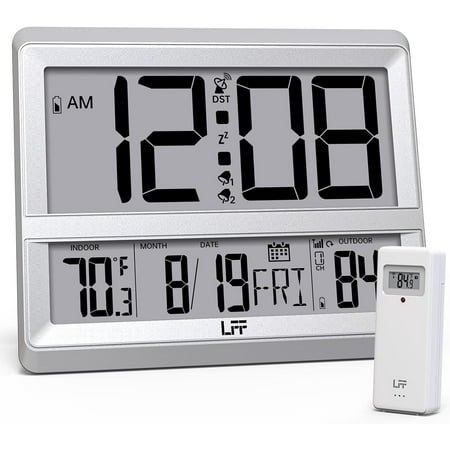
Atomic Clock Large Display, Digital Wall Clock with Indoor Outdoor Temperature and Date, Wireless Outdoor...
Overview
Walmart's LWC205 pairs a WWVB atomic clock with one wireless outdoor-temperature sensor. The 8.66-by-7.48-by-1.1-inch display also shows indoor temperature, calendar, weekday, daylight-saving status, and two alarms.
Key Features
- Sensor range stated up to 330 feet
- Eight selectable North American time zones
- Wall holes, a tabletop kickstand, and snooze function
Considerations
Still, the LCD has no backlight, a limitation the seller states directly. Walmart claims daily synchronization within one second, but that performance depends on receiving the Colorado broadcast and was not independently tested here. Seller-listed ranges are 32–122°F (0–50°C) indoors and -58–158°F (-50–70°C) outdoors. Actually, the listing says battery operated without giving battery sizes or counts for either unit. Warranty, display-digit height, humidity sensing, and alarm-volume details are also absent. The seller includes one sensor and a user manual, but no batteries are listed among package contents.
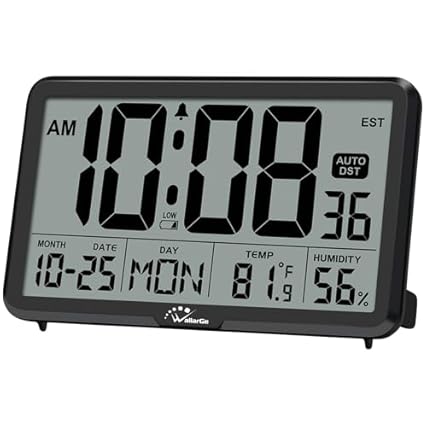
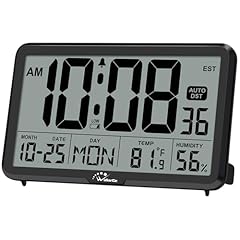
WallarGe Auto Set Digital Wall Clock Battery Operated, Desk Clocks with Temperature, Humidity and Date,...
Overview
WallarGe's CL6002 is an auto-set digital calendar clock with indoor temperature, humidity, alarm, and eight time-zone choices. Its 8.6-by-5.2-inch plastic case can hang on a wall or stand on a desk.
Key Features
- Three-AA battery operation
- Eight-minute snooze
- Twelve- or twenty-four-hour display
Considerations
Yet, this listing explicitly labels the clock non-atomic, so auto-set should not be confused with WWVB synchronization. The three AA batteries are not included, and the display has no backlight. Amazon attributes sensing to an SHTC3 component but supplies no accuracy tolerance. Still, warranty terms, alarm loudness, digit height, and the purpose or inclusion of the separate memory battery remain unclear. The listing gives a saved weight of 13.4 ounces and identifies the body material as plastic in this record.
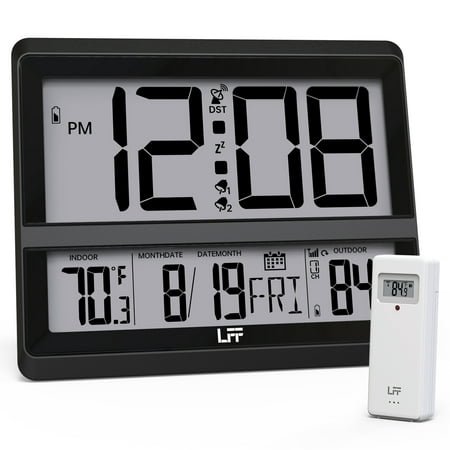
Atomic Clock Large Display, Digital Wall Clock with Indoor Outdoor Temperature and Date, Wireless Outdoor...
Overview
Walmart item 1559616357 is a black battery-operated atomic wall-or-desk clock with an included wireless outdoor-temperature sensor. The main display measures 8.66 by 7.48 by 1.1 inches and also shows indoor temperature, date, and weekday.
Key Features
- Dual alarms with snooze
- Eight North American time-zone choices and optional automatic DST
- Clock: three excluded AA cells; sensor: two excluded AAA cells
Considerations
The same source gives both 100 feet and 330 feet as the sensor range, so placement capability is unresolved. Seller-listed temperature ranges are 32–122°F indoors and -58–158°F outdoors. WWVB synchronization is promoted as accurate within one second, but reception conditions and measurement tolerance are not supplied. Backlight, humidity, alarm volume, snooze interval, sensor weather rating, wall hardware, battery life, warranty, and package instructions are absent. Confirm the exact black model, included sensor, usable range through walls, zone list, mounting method, seller, and returns.

BALDR Atomic Alarm Clock - Large Color Display Digital Desk Clock - with Indoor Temperature & Humidity -...
Overview
BALDR's black atomic alarm clock uses a color LCD for time, date, weekday, indoor temperature, humidity, and moon phase. A top button provides snooze. Amazon says WWVB setup occurs mainly overnight and the receiver is intended for North America.
Key Features
- Four backlight levels including off
- Included AC adapter
- 6.3-by-4.52-inch tabletop case

Considerations
The clock must remain plugged in to operate. Its CR2032 cell stores time and alarm settings during an outage; it does not run the display. Oddly, the description calls that cell built in, while a saved field says batteries are not included. Confirm the current package. The seller provides no warranty term, alarm sound specification, or radio-reception range. Saved fields list the plastic clock at 11.3 ounces and do not identify a wall-mounting option.
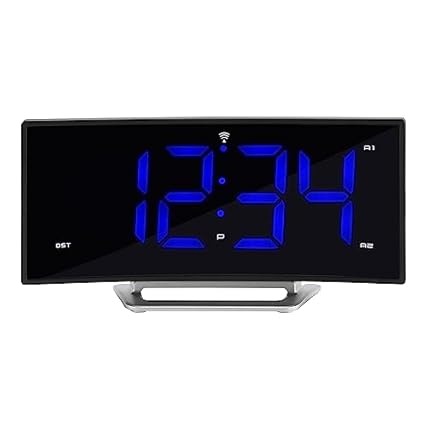
La Crosse Technology 617-249 1.8" Curved Blue Digital Atomic Dual Alarm Clock, 6.60" L x 1.55" W x 3.45" H,...
Overview
La Crosse Technology 617-249 is a black corded atomic alarm clock with a curved blue LED and 1.8-inch time display. Its body is listed at 6.6 inches long, 1.55 inches deep, and 3.45 inches high.
Key Features
- Dual alarms with four-stage ascending sound
- Programmable five-to-sixty-minute snooze
- One-amp USB charging port plus adjustable brightness and volume
Considerations
The included 5-volt adapter powers normal operation. A supplied coin cell has no documented purpose or outage behavior. The saved battery field says CR2 while package contents say CR2032; confirm its type. A seven-minute WWVB search disables buttons, dims the display, and stops USB charging. The clock retries overnight and should sit at least three feet from electronics. Manual time and DST controls are available. The source lists a stand, setup guide, and one-year limited parts-and-labor warranty. A charging cable is not included; USB compatibility, reception zones, and alarm decibels are unspecified.

Sharp Atomic Desktop Clock – Auto Set Digital Alarm Clock - Atomic Accuracy - Easy to Read Screen with...
Overview
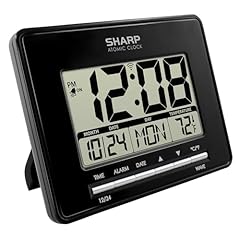
Sharp SPC932 is a battery-powered atomic desktop or wall clock with a 6.45-inch-wide by five-inch-high plastic case. Its digital screen shows WWVB-synchronized time, date, weekday, and indoor temperature.
Key Features
- Three excluded AAA batteries
- Built-in tabletop stand and wall-mount support
- Five-second backlight activated by the top snooze button
Considerations
The backlight also comes on when the alarm sounds. Sharp says the receiver updates daily from the NIST broadcast and remains accurate within one second, but reception and accuracy were not independently measured. The source does not list supported time zones, manual-set fallback, daylight-saving controls, snooze interval, alarm duration or volume, temperature tolerance, digit height, hanger geometry, fastener, battery life, or warranty. A saved weight of 1.01 pounds is unusually high for the stated size and should be checked. Confirm model SPC932, placement hardware, reception indicators, seller, and returns.

Atomic Clock Wall with Indoor/Outdoor Temp & 10.5" Large LCD Display, Black
Overview
B0FHVBSTYQ is a black atomic wall-or-table clock with a 10.5-inch LCD and wireless indoor/outdoor temperature display. It supports 12/24-hour time, calendar information, alarm, snooze, low-battery warnings, and Celsius/Fahrenheit selection.
Key Features
- Four United States time zones with automatic DST
- Seller-stated 330-foot wireless range and support for three sensors
- Three AA cells for the clock and two AA cells for the outdoor sensor

Considerations
All five batteries are excluded; the seller says not to use rechargeable batteries. Two brackets and three hanging holes support desk or wall placement. The description discusses one outdoor sensor but does not itemize the package or identify additional compatible sensor models. WWVB updates, range, and temperature performance are untested seller claims. Backlight, humidity, body dimensions, digit height, snooze interval, alarm volume, sensor weather rating, warranty, and fasteners are missing. Confirm sensor inclusion, battery access, usable range, mounting hardware, seller, and returns.

Geevon Digital Atomic Alarm Clocks with 2 USB Ports for Seniors Elderly
Atomic Reception and Auto-Set Are Different Systems
Eight final clocks identify WWVB or atomic radio synchronization: La Crosse 617-249, Walmart LWC205, Sharp SPC932, BALDR, Walmart item 1559616357, Geevon, B0FHVBSTYQ, and Sharp B09417PQ16. DreamSky DS305 instead loads stored time when first plugged in, and WallarGe CL6002 explicitly says non-atomic. Those two can reduce setup without receiving the government broadcast. Reception still depends on location, building materials, interference, and supported zones. La Crosse begins with a seven-minute search, retries overnight, and advises three feet of separation from electronics. BALDR also describes overnight acquisition and North American use. Zone support ranges from four choices on several clocks to eight on LWC205 and item 1559616357. Confirm a manual-set fallback if the clock will be used outside the reception area or in a room with weak signal.
Choose Continuous Dimming or Brief Button Lighting
DreamSky DS305 and La Crosse 617-249 are corded choices with adjustable always-powered displays; DreamSky offers a zero-to-100-percent dimmer, while La Crosse lists adjustable brightness for its 1.8-inch blue LED. BALDR uses four stated levels, including off. Battery models conserve power differently. WallarGe and Walmart LWC205 expressly have no backlight. Sharp SPC932 lights for five seconds from the snooze button and also illuminates when its alarm sounds; Geevon provides a ten-second blue light. The other final sensor clocks do not provide enough lighting detail to promise nighttime readability, so verify the exact display before placing one across a bedroom. Also separate digit size from body or screen size: a 10.5-inch LCD on B0FHVBSTYQ does not mean 10.5-inch numerals. Compare character height, viewing angle, lowest brightness, color, and whether temperature remains legible at the intended distance.
Read Main Power Sensor Power and Backup Separately
DreamSky, La Crosse, and BALDR require an adapter for normal illuminated operation. DreamSky's CR2032 stores settings but cannot light the display or sound the alarm. BALDR likewise uses a coin cell for memory, with conflicting inclusion fields. La Crosse includes a 5-volt adapter and a coin cell, but its records disagree between CR2 and CR2032. Battery-only clocks continue while their cells have charge: WallarGe uses three AA, Sharp SPC932 three AAA, Geevon two AAA, and item 1559616357 uses three AA in the clock plus two AAA in its sensor. B0FHVBSTYQ uses three AA plus two AA and prohibits rechargeable cells. Sharp B09417PQ16 uses three AA plus two AAA. LWC205 omits both battery sizes and counts despite being battery operated. Confirm every compartment and included cell before purchase; a sensor battery is not a backup battery for the main clock.
Compare Outdoor Sensors Ranges and Placement Hardware
Four final records describe outdoor sensing. Walmart LWC205 states a 330-foot wireless range but omits battery details. Item 1559616357 gives both 100 and 330 feet in the same source, so its usable distance must be confirmed. B0FHVBSTYQ states 330 feet and support for up to three sensors, although the included sensor count and compatible add-on model are unclear. Sharp B09417PQ16 includes one sensor but supplies no range. Walls, metal surfaces, weather, and weak cells can reduce any open-air figure. The remaining clocks show indoor conditions only: DreamSky, La Crosse, Sharp SPC932, and Geevon list temperature, while WallarGe and BALDR add humidity. No product here provides a common accuracy test. Check sensor weather rating, channel pairing, temperature tolerance, replacement availability, stand or wall hardware, and reception indicators for the actual installation rather than comparing headline range alone.