Side-by-Side Comparison
Digital Projection Snooze Alarm Clocks



Open the comparison detailsCompare the criteria for the picks shown above.Show detailsHide details
Top 10 Of The Best Digital Projection Snooze Alarm Clocks

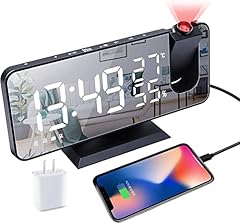
Projection Alarm Clock for Bedroom Ceiling, Digital Clock Projector with Weekday/Weekend Mode, Date,...
Overview
Mesqool CR1024 is a 7.87-by-3.43-by-2.36-inch projection clock with a 5.9-inch LED display. Its blue 180-degree focusing projector shows time, while the main screen adds date, weekday, temperature, humidity, and two alarms.
Key Features
- Dual alarms support Monday-through-Sunday, weekdays, weekends, or one-time schedules with nine-minute snooze.
- Seven alarm-volume levels and five shared brightness levels control the beep, screen, and projection.
- Type-C and USB charging ports are included, while two excluded AAA cells preserve settings during outages.
Considerations
The clock needs external power for normal display and projection, but the description does not say whether an adapter is included or detail the input cable and backup-only behavior. Verify the required power supply, charger outputs, night-light controls, projection distance and orientation, sensor ranges, cable length, and whether screen and projection brightness adjust independently. Temperature and humidity accuracy are seller claims without tolerances.

Projection Alarm Clock for Bedrooms Ceiling, Alarm Clock Radio with USB Charger Port, Temperature &...
Overview
This 7.3-inch mirror-screen projection clock combines time projection with FM radio, dual alarms, adjustable volume, temperature and humidity information, USB charging, and a sleep timer. The projector rotates 180 degrees and uses a focus ring.
Key Features
- FM tuning spans a stated 76 to 108 MHz, with a five-to-ninety-minute auto-off timer.
- Two alarms use fifteen volume levels and a fixed five-minute snooze.
- A USB charging port and included memory battery retain time, alarm, radio, and snooze settings during outages.
Considerations
The description claims indoor and outdoor readings but does not identify an included remote sensor, its batteries, channel, or range. It also calls station storage unlimited without explaining memory. Verify normal power adapter, display dimmer steps, projection range and brightness, outage display behavior, radio presets, USB output, and whether the mirror surface reflects unwanted room light.

JXTZ Projection Alarm Clock, Alarm Clocks with Projection on Ceiling with 7.9" Large Display, LED Digital...
Overview
JXTZ WA113 has a 7.9-inch LED screen for time, date, and temperature plus a ceiling or wall time projector. It runs from a supplied 1.5-meter USB cable, but the required wall adapter is explicitly excluded.
Key Features
- Projection is specified from 1.6 to 16 feet with three brightness levels.
- Three weekday schedules accompany snooze adjustable from one to sixty minutes, with five minutes as default.
- The screen has four brightness levels and an editable night mode initially set for 18:00 to 7 a.m.
Considerations
A backup battery saves time and alarm settings but cannot keep the LED screen on without USB power. Confirm the backup cell type and inclusion, USB supply rating, alarm volume, projection angle, focus and image flip, temperature sensing range, case dimensions, and whether projection brightness is independent. Budget for a compatible adapter and safe cable route at the bedside.
Also featured in: Best Brand Projection Clocks, Best Projection Alarm Clocks With Temperature

JXTZ Projection Alarm Clock for Bedroom Ceiling, 8.5" Large Display Alarm Clock with 180° Rotatable...
Overview
JXTZ WA183 is a plug-in projection clock with an 8.5-inch oval screen, 180-degree time projector, and seventeen ambient-light modes. A 1.5-meter USB cable is supplied, but a wall adapter is not.
Key Features
- The projection has two brightness levels, while the main display offers four.
- One alarm, snooze, and three recurring schedule choices are stated for work or school routines.
- The screen supports 12- or 24-hour time and also names temperature and weekday display in the title.
Considerations
The schedule text says Monday-Friday, Monday-Saturday, and Sunday-Monday; the last range is likely an error and needs menu verification. No snooze interval, alarm volume, projection distance, focus, image flip, backup memory, cable input rating, case dimensions, or temperature range is supplied. Confirm that all seventeen light modes can be dimmed or switched completely off.

DR.PREPARE Projection Alarm Clock, Digital Clock Projector on Ceiling with Indoor/Outdoor Temperature...
Overview
DR.PREPARE combines a colorful LCD weather display with time-and-temperature projection, dual alarms, adjustable snooze, and support for a wireless outdoor sensor. The main unit alternates indoor and outdoor temperature in the projected image every five seconds.
Key Features
- The screen shows time, temperature minima and maxima, humidity, and weather information at four brightness levels including off.
- Two rear alarm switches accompany snooze adjustable from five to sixty minutes.
- An included AC adapter runs the lit display; two excluded AAA cells retain settings during a blackout.

Considerations
Battery-only mode does not keep the screen lit and allows no adjustments. The description discusses a wireless remote sensor but does not clearly list its inclusion, battery, channel count, range, or exposure limits. Verify package contents, projection distance, focus, alarm volume, forecast method, sensor accuracy, and whether humidity comes from the main unit, remote unit, or both.
Also featured in: Craig Projection Alarm Clocks Mixed-Brand Listings, Best Sony Projection Dual Alarm Clocks, Best Projection Self Setting Clocks, Best Oregon Scientific Slim Black Line Projection Clocks, Best Naxa Projection Dual Alarm Clocks, Best Multi Function Digital Weather Projection Alarm Clocks, Best Weather Projection Alarm Clocks, Best Projection Alarm Clocks With Temperature, Best Oregon Scientific Projection Alarm Clocks
Projection Alarm Clock for Bedrooms with Indoor Outdoor Temperature Display, Dual Alarms Multi-Colored...
Overview
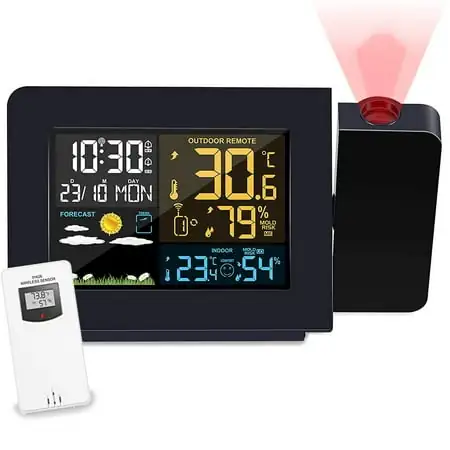
This Walmart projection weather station uses a 4.5-inch color LCD, soft-red time and temperature projection, dual alarms, and one included wireless sensor. It shows indoor and outdoor temperature and humidity, weather graphics, pressure trend, temperature trend, and mold alerts.
Key Features
- The projector angle and brightness adjust, and its image can be reversed 180 degrees.
- One sensor is included with a claimed open-area range up to 200 feet; the receiver supports three channels.
- Dual alarms use weekday or weekend schedules, while snooze adjusts from five to sixty minutes or can be disabled.
Considerations
The DC adapter powers four backlight states, but the listing omits sensor and backup batteries, case dimensions, projection distance, alarm volume, and outage behavior. Treat twelve-hour forecasting, measurement accuracy, mold risk, and 200-foot range as seller claims affected by placement. Verify sensor weather protection, extra-channel compatibility, barometer setup, and what values alternate in projection.

SMARTRO SC91 Projection Alarm Clock for Bedrooms with Weather Station, Wireless Indoor Outdoor Thermometer,...
Overview
SMARTRO SC91 is a projection weather station with a 4.5-inch color LCD, one wireless outdoor sensor, dual alarms, and indoor-outdoor temperature and humidity. Its soft-red projection alternates temperature values and can be reversed 180 degrees.
Key Features
- The receiver supports three sensor channels, with one sensor included and a claimed 200-foot open-area range.
- Weather patterns, pressure and temperature trends, mold alerts, date, and weekday appear on the main screen.
- Dual recurring alarms use weekday or weekend schedules and snooze from five to sixty minutes or off.

Considerations
The listing explicitly says this clock is not atomic, so time requires manual setting. Confirm DC adapter, backup and sensor batteries, case size, projection distance and focus, alarm volume, forecast setup, sensor weather protection, and extra-sensor model. Measurement accuracy, forecast horizon, mold indication, and transmission range are seller claims rather than independent results.
ROCAM Projection Alarm Clock for Bedroom, Digital Clock with Projector on Ceiling Wall, Projection Clock...

ORIA Projection Alarm Clock, Electronic LED Clock, 7.8" Mirror Digital Desk Alarm Clock with Temperature,...
Overview
ORIA uses a 7.8-inch mirror LED screen and a rear-facing projector that rotates from minus 90 to plus 90 degrees. The interface cycles through time, date, temperature, and alarm modes and offers one recurring schedule.
Key Features
- Projection brightness has two levels; the screen has four levels plus automatic nighttime dimming.
- Alarm schedules cover weekdays, Monday through Saturday, or every day, with fixed five-minute snooze.
- A one-meter USB cable supplies normal power; a CR2032 cell preserves time settings when disconnected.

Considerations
No charger is included, and the backup cell does not run the always-on screen. The projector only aims behind the clock; aiming forward turns the image upside down, so bedside orientation matters. Verify projector focus and distance, alarm volume, temperature range, automatic dimming override, CR2032 inclusion, USB input rating, and mirror glare in the intended room.
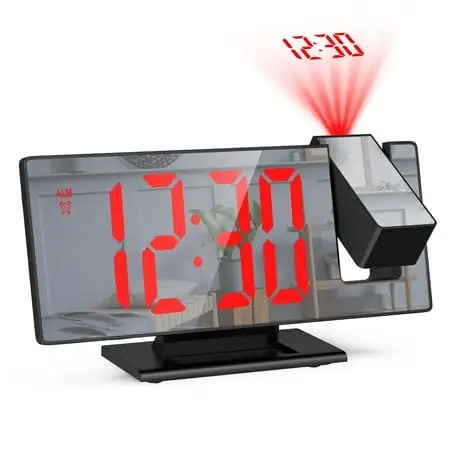
Projection Alarm Clock, AMIR Digital Clock 7.8'' LED Mirror Display Snooze 12/24H Digital Alarm Clock for...
Will the projector work from the intended bedside position?
Most models rotate the projector or image through 180 degrees, but that does not guarantee every placement. ORIA projects only behind its body and displays an upside-down image when aimed forward. JXTZ WA113 documents a 1.6-to-16-foot range, while several clocks omit distance, focus, and image-flip details. Mesqool and AMIR name focus adjustment; weather-station models may alternate time and temperature. Measure the distance and angle to the wall or ceiling, decide which value should project, and verify brightness control. Cable routing and control access must still work after the clock is turned toward the projection surface.
Which batteries run the clock, and which only remember settings?
FUNOMOCYA is the only clearly cordless model here, using two AAA cells for normal operation. Mesqool and DR.PREPARE use two AAA batteries only for memory, AMIR uses a button cell, ORIA uses a CR2032, and JXTZ WA113 names an unspecified backup. Their displays and projectors still need external power. WA113, WA183, and ORIA provide USB cables but no wall adapter; DR.PREPARE says its adapter is included. Backup wording should be split into four questions: does it preserve time, sound the alarm, illuminate the display, and run projection? Verify each function rather than assuming the whole clock survives an outage.
How flexible are the alarms, snooze, and night controls?
Mesqool offers two alarms, four schedule types, seven volume levels, and nine-minute snooze. AMIR is simpler with one alarm, a two-minute ring, and nine-minute repeat. JXTZ WA113 provides weekday schedules and one-to-sixty-minute snooze; WA183's schedule wording contains a Sunday-Monday conflict. DR.PREPARE, the Walmart weather station, and SMARTRO pair dual alarms with five-to-sixty-minute snooze. Screen and projection brightness often use different scales, and ambient-light models add another control. Confirm alarm volume, repeat schedule, snooze range, automatic dimming hours, and whether every light can be switched fully off.
Do you need weather sensors, radio, charging, or only projected time?
AMIR focuses on time projection and omits date and climate data. Mesqool adds indoor temperature and humidity plus two charging ports. The 7.3-inch mirror clock adds FM and a sleep timer but leaves its outdoor-sensor package unclear. DR.PREPARE, the Walmart station, and SMARTRO add remote outdoor readings and weather information; SMARTRO explicitly is not atomic. The Walmart station and SMARTRO include one sensor, while DR.PREPARE needs package confirmation. Choose extras by a real use case, then verify sensor batteries, range, exposure limits, forecast setup, radio presets, charging output, and whether a claimed reading appears on the screen, projection, or both.
Related Guides: Creative Led Alarm Clocks

Best Creative Led Alarm Clocks

Best Coby Projection Digital Alarm Clocks

Best Digital Lcd Talking Led Projection Alarm Clocks
Best Digital Weather Lcd Projection Snooze Alarm Clocks