
Side-by-Side Comparison
Howard Miller Dual Chime Clocks



Open the full side-by-side comparisonSee the full criteria table for all top picks when you need the extra detail.Show detailsHide details
Top 10 Of The Best Howard Miller Dual Chime Clocks

Howard Miller Kooskia Mantel Clock II 547-721 – Windsor Cherry with Quartz & Dual-Chime Movement
Overview
Howard Miller Kooskia II 549721 is a Windsor Cherry mantel clock with a burl-veneer front panel, aged Arabic-numeral dial, serpentine hands, and convex crystal. Its dimensions mirror Anthony, but it remains a separate model and finish.
Key Features
- At 4.64 pounds, Kooskia spans 15.75 by 8.5 by 5.25 inches.
- The quartz movement offers Westminster or Ave Maria hourly and at quarter-hour intervals.
- Automatic nighttime shutoff and volume control operate with two excluded C batteries.
Considerations
Confirm model 549721 because one style field uses an unrelated Garden City II name. Compare the front panel and finish against Anthony rather than assuming equal appearance from identical dimensions. Verify base stability, rear battery clearance, chime selection, quarter-hour cancellation, shutoff timing, lowest volume, and crystal glare at the intended mantel height.
Also featured in: Best Howard Miller Quartz Wall Clocks, Best Medford Quartz Mantel Clocks
Howard Miller 635113 8-1/2" X 15-3/4" Anthony Hardwood Analog Table Top Clock - Yorkshire
Overview
This Walmart listing is another Howard Miller Anthony 635113 rather than a separate clock. It repeats the Oak Yorkshire hardwood-and-veneer mantel case, burl front panel, carved scrolls, and German quartz dual-chime movement under a retailer-specific identity.
Key Features
- Model 635113 is identified as the Yorkshire hardwood analog tabletop Anthony clock.
- The movement provides dual chimes, user volume control, and automatic nighttime volume reduction.
- Automatic nighttime shutoff is available, and two excluded C batteries provide power.
Considerations
Use current images and model code to confirm it matches the Anthony card above. Verify complete dimensions, retailer package contents, battery access, chime melody selection, quarter-hour options, quiet mode, volume range, and shelf stability. Comparing the two Anthony listings as different designs would double-count one model; choose between merchants only after identity and supplied contents agree.

Howard Miller Lewiston Mantel Clock II 549-727 – Hampton Cherry Finish, Vintage Home Decor, Brass Finished...
Overview
Howard Miller Lewiston II 549-727 is a Hampton Cherry mantel clock with reeded columns, carved caps, Roman numerals, and a visible brass-finish round pendulum. Its taller profile offers a pendulum presentation without wall mounting.
Key Features
- The mantel case is listed at 10.5 inches wide, 13.5 high, and 4.5 deep.
- Westminster or Ave Maria chimes can sound hourly and at three quarter-hour points.
- Volume control and automatic nighttime shutoff accompany two excluded C batteries.
Considerations
The metric conversion attached to the 4.5-inch depth says one centimeter, which is inconsistent, so rely on a fresh axis-labeled measurement before fitting the shelf. Confirm the 6.43-pound weight, model number, pendulum clearance, base stability, battery access, chime schedule, and quiet mode. Generic atomic and wall-mount fields also conflict with the described quartz mantel format.

Howard Miller Arendal Wall Clock 625-377 ? Tuscany Cherry Finish, Wooden Stick Pendulum & Brass Finished...
Overview
Howard Miller Arendal 625-377 is a narrow Tuscany Cherry wall clock with an aged Roman-numeral dial, wooden pendulum stick, and antique-brass-finish bob. Its nine-inch width suits a slimmer wall bay than Clay or LaGrange.
Key Features
- The case measures 29.5 inches high, nine wide, and 4.5 deep at 8.5 pounds.
- A quartz dual-chime movement selects Westminster or Ave Maria with quarter-hour options.
- Volume control and automatic nighttime shutoff operate from two excluded C batteries.
Considerations
Measure the full pendulum swing and leave rear access for both C cells. Confirm wall hanger, hardware, chime preview, hourly and quarter-hour programming, shutoff schedule, and lowest volume. One product detail also calls the clock silent, which conflicts with its musical chime role unless that label refers only to timekeeping between strikes; verify the intended meaning before bedroom placement.

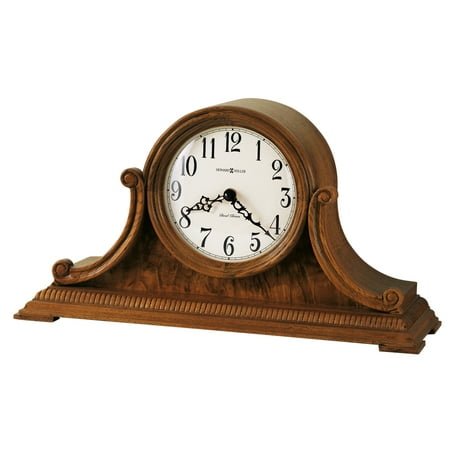
Howard Miller Anthony Mantel Clock 635-113 ? Oak Yorkshire with Quartz & Dual-Chime Movement
Overview
Howard Miller Anthony 635-113 is a traditional mantel clock in an Oak Yorkshire finish over select hardwoods and veneers. Its wide low case uses an aged dial, carved side scrolls, burl front panel, and two selectable chime melodies.
Key Features
- The case measures 15.75 inches wide, 8.5 high, and 5.25 deep at 4.3 pounds.
- Westminster or Ave Maria can sound hourly and at quarter-hour intervals through the quartz movement.
- Two excluded C cells support adjustable chime volume and automatic nighttime silence.
Considerations
Confirm the exact quarter-hour programming choices, minimum volume, shutoff schedule, chime preview, and whether the clock can run silently while keeping time. Check shelf depth, front clearance for the convex crystal, rear battery access, and stability on the chosen mantel. This listing and the Walmart Anthony card represent the same 635-113 model, not two distinct designs.
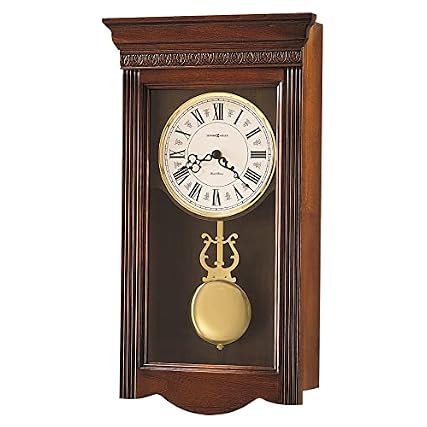
Howard Miller Eastmont Wall Clock, Wooden Finish with Golden Pendulum | Round Cream Dial with Roman...
Overview
Howard Miller Eastmont 620154 is a Windsor Cherry wall clock with an embossed broad pediment, cream Roman-numeral dial, and polished-brass lyre pendulum. Its dual-chime quartz movement offers a traditional tall-clock sound program in a wall format.
Key Features
- The wood-finish case uses select hardwoods and veneers with a decorative brass bezel.
- Westminster and Ave Maria are selectable melodies for hourly chiming.
- Quarter-hour strikes and volume control accompany the visible lyre pendulum.
Considerations
The listing does not supply case dimensions, depth, weight, battery type and count, cell inclusion, night-shutoff schedule, rear hanger, or mounting hardware. Defer purchase until those installation and power details are confirmed. Also verify the Roman III treatment, pendulum clearance, chime-selection procedure, lowest volume, and whether quarter-hour strikes can be disabled independently from the hourly melody.

Howard Miller Clay Wall Clock II 547-468 – Golden Oak, Brass Pendulum Home Decor with Quartz Dual-Chime...
Overview
Howard Miller Clay Wall Clock II uses a Golden Oak hardwood-and-veneer case, arched pediment, fixed blue moon phase, and brass-finish lyre pendulum. It is one of the heavier and broader wall installations in the set.
Key Features
- The case is 28.5 inches high, 13.5 wide, and five deep at 14.47 pounds.
- Westminster or Ave Maria can play hourly with optional quarter-hour strikes.
- Automatic nighttime chime shutoff and volume control accompany two excluded C batteries.

Considerations
Confirm the model label because the title and item details use different 547-468 and 549468 numbering. Plan a wall fastener for the verified 14.47-pound load, with clearance for the pendulum and five-inch projection. Check hanger geometry, supplied hardware, moon-phase decoration, battery-door access, chime schedule, lowest volume, and whether quarter-hour strikes can be disabled.
Also featured in: Best Howard Miller Britannia Brass Wheel Clocks

Howard Miller Lambourn I Wall Clock – Wooden Wall Clock Reeded Columns Serpentine Hands Brass Lyre Pendulum...
Overview
Howard Miller Lambourn I 620220 is a Windsor Cherry wall clock with reeded columns, an off-white dial, serpentine hands, and a brass lyre pendulum. The listing emphasizes selectable melodies and automatic sound control but gives almost no physical setup specifications.
Key Features
- The wooden wall case uses a brass-accented lyre pendulum and traditional analog dial.
- Westminster and Ave Maria are the two named choices for the dual-chime movement.
- Automatic chime shutoff is stated, but its schedule and control behavior are not supplied.

Considerations
Dimensions, weight, battery type and count, cell inclusion, volume adjustment, quarter-hour behavior, shutoff schedule, hanger, and hardware are missing from this listing. Postpone ordering until the seller supplies the current manual and complete wall envelope. Confirm pendulum swing, rear projection, battery access, fastener rating, and whether the melody or striking schedule can be changed without removing the clock.

Howard Miller Windsor Mantel Clock II 549-606 – Americana Cherry with Quartz, Dual-Chime Movement
Overview
Howard Miller Windsor II 549-606 is a broad Americana Cherry mantel clock with carved overlays, an arched crown, off-white Arabic-numeral dial, and convex glass. The 18-inch width makes it the widest mantel case in this list.
Key Features
- Overall dimensions are 18 inches wide, 11.75 high, and 6.75 deep at 6.07 pounds.
- A German quartz movement selects Westminster or Ave Maria with quarter-hour striking.
- Automatic nighttime chime shutoff and volume control use two excluded C batteries.

Considerations
Verify that the surface can accommodate the full 6.75-inch depth and leave rear room for battery replacement and setting controls. Confirm chime preview, quarter-hour cancellation, shutoff timing, lowest volume, crystal reflections, and foot stability. A generic wall-mount field conflicts with the mantel form, so do not plan hanging installation without explicit manufacturer hardware and instructions.
Also featured in: Top 6 Best Luxury Tabletop Clocks to Elevate Your Space, Best Rhythm Quartz Mantel Clocks, Best Howard Miller Quartz Wall Clocks, Best Lion Mantel Quartz Clocks, Best Howard Miller Chiming Mantel Clocks, Best Spartus Western Mantel Clocks, Best Dual Chime Mantle Clocks, Best Cherry Quartz Mantel Clocks

Howard Miller LaGrange Wall Clock II 549-444 – Golden Oak Home Decor with Brass Pendulum with Quartz...
Overview
Howard Miller LaGrange II 549-444 is a Golden Oak wall clock with carved overlays, brass-finish lyre and grid pendulum, fixed moon phase, and a brushed-brass-finish dial. It is the tallest documented wall model here.
Key Features
- The case measures 30.5 inches high, 14 wide, and five deep.
- Westminster or Ave Maria can sound each hour with optional quarter-hour strikes.
- Volume control and automatic nighttime shutoff run with two excluded C batteries.

Considerations
The listing does not supply weight, hanger geometry, mounting pieces, or the complete pendulum swing envelope. Confirm those before selecting an anchor and wall location. Check the fixed moon-phase detail, glass reflections, battery access, chime programming, minimum volume, and quiet period. Allow clearance below and behind the 30.5-inch case for motion and maintenance.
Which clocks belong on a mantel and which require wall installation?
Anthony, its duplicate Walmart listing, Lewiston II, Windsor II, and Kooskia II are mantel formats. Anthony and Kooskia share a 15.75-by-8.5-by-5.25-inch envelope, but their identities and finishes differ. Lewiston is taller with a visible pendulum, and Windsor is widest at 18 inches. Eastmont, Clay, Arendal, Lambourn, and LaGrange are wall clocks with pendulums and need verified hangers, anchors, rear clearance, and swing space. Generic mounting fields conflict on several records, so follow the case form and current model instructions. Measure the complete furniture surface or wall envelope, including convex glass, pediments, pendulum travel, battery access, and control reach.
How do Westminster, Ave Maria, and quarter-hour programs work?
All ten listings describe a dual-chime choice centered on Westminster or Ave Maria. Most detailed models can strike on the hour and at the quarter, half, and three-quarter points. A quarter-hour program can create four sound events per hour, which is materially different from one hourly melody. Eastmont and Lambourn need fuller manuals to confirm every control, while the Anthony, Clay, Arendal, Lewiston, Windsor, LaGrange, and Kooskia descriptions state more of the pattern. Before choosing a room, verify whether melody and strike are combined, how preview works, whether quarter strikes can be disabled independently, how volume changes, and whether the clock keeps time when all sound is off.
Which size, weight, and clearance details matter most?
Clay is 28.5 inches high and 14.47 pounds; Arendal is 29.5 inches high, nine wide, and 8.5 pounds. LaGrange reaches 30.5 inches but omits weight. Windsor needs 18 inches of shelf width and 6.75 inches of depth, while Anthony and Kooskia each need 5.25 inches of depth. Lewiston's inch-to-centimeter depth conversion conflicts and should be remeasured. Eastmont and Lambourn lack usable dimensions and weight. Wall models need pendulum swing and anchor planning; mantel clocks need stable surfaces and rear service space. Confirm whether stated dimensions include every crown, bob, glass projection, and moving element.
What battery, quiet-hours, and duplicate-model checks remain?
The detailed clocks generally require two excluded C batteries for quartz timekeeping and chime operation. Eastmont and Lambourn omit a usable battery specification. Automatic nighttime shutoff appears across the family, and some records also mention nighttime volume reduction, but exact hours and independent controls need confirmation. Test the selected quiet program against the household's sleep schedule and room use. The Amazon and Walmart Anthony entries both identify model 635-113, so count them as retailer choices for one clock rather than separate designs. Reconcile Clay's model numbering, Lewiston's depth conversion, Kooskia's stray style name, and any wall-versus-mantel field conflict before matching manuals or accessories.
Alternatives to Howard Miller Mantel Clocks

Best Howard Miller Trevisso Clocks

Best Howard Miller Brass Mantel Clocks

Best Howard Miller Chiming Mantel Clocks
Related Articles


Latest Review Posts

Hook for Hanging a Heavy Wall Clock: How to Choose Hardware That Actually Holds

Replacement AA Battery Holders for Clocks: Fit, Safety, and Affordable Options

Bulk AA Batteries for Clocks: Packs That Save Money Without Sacrificing Life

Should You Use Rechargeable Batteries For Clocks and Which Packs To Buy

Best Kids’ Alarm Clocks