Side-by-Side Comparison
Small Digital Alarm Clocks


Open the full side-by-side comparisonSee the full criteria table for all top picks when you need the extra detail.Show detailsHide details
Top 10 Of The Best Small Digital Alarm Clocks

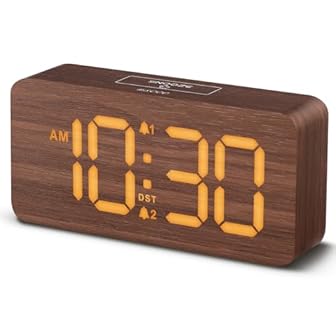
DreamSky Wooden Digital Alarm Clocks for Bedrooms - Electric Desk Clock with Large Numbers, USB Port, Loud...
Overview
DreamSky DS2201 is the black wood-face electric clock. Its structured size is 5.96 inches wide by 2.7 inches high, weight is 10.86 ounces, and the display uses 1.8-inch LED numerals.
Key Features
- Five brightness levels plus Off accompany switchable 12- and 24-hour time.
- Five alarm-volume levels, a two-minute alarm, and nine-minute snooze are seller-listed.
- The included adapter powers the display, while a USB port can charge another device.
Considerations
Two excluded AAA batteries operate the alarm during an outage but do not illuminate the display. Manual DST changes the hour rather than synchronizing automatically. The source names a one-year replacement warranty without full terms and gives no USB output rating, alarm decibel measurement, dimmer luminance, clock depth, or independent runtime and accuracy results.
Also featured in: Best Wooden Table Clocks, Best Wood Grain Alarm Clocks, Best Elegant Design Alarm Clocks, Best Wood Digital Alarm Clocks, Best Wood Grain Led Alarm Clocks, Best Wood Led Digital Alarm Clocks, Best Kitchen Digital Alarm Clocks, Best Fully Dimmable Alarm Clocks, Best Modern Contemporary Alarm Clocks, Best Classic Alarm Clocks, Best Directors Edition Digital Alarm Clocks, Best Bradley Alarm Clocks

Battery Operated Digital Clock: Cordless Small Alarm Clock for Bedroom Travel - Large Numbers 4 Dimmers for...
Overview
Acedeck T01 B0DJYBMHZF is the red-digit cordless variant. The plastic tabletop case is listed at 5.6 inches wide, 2.8 inches high, 4.8 ounces, with 1.8-inch LED numerals.
Key Features
- Four AA alkaline batteries provide normal operation; a USB-C cable offers another power path.
- Three manual brightness choices, display Off, and an ambient auto-dimming sensor are described.
- Three alarm-volume levels, ten-minute snooze, and manual DST are listed.
Considerations
The USB-C adapter is excluded, as are the batteries, and the seller says not to use rechargeable cells. Battery operation is limited to 12-hour time display rather than 24-hour format. A claimed runtime of up to 12 months, warranty wording, brightness behavior, and alarm strength are not independently verified. Case depth and USB input requirements are absent.

Netzu 3-in-1 Digital Clocks for Living Room with Temperature, Date & Time Display - 4 Levels Birghtness, 3...

Srubambi Battery Operated Small Alarm Clock: Compact Cordless Design
Overview
Srubambi T02-1 is a cordless alarm clock with green digits, an always-lit display according to the seller, and an ambient-light sensor for automatic dimming. Its listed size is 2.32 by 4.88 by 1.22 inches and its weight is 0.23 lb.
Key Features
- Four AA batteries power the clock, and they are not included.
- The seller lists three brightness levels plus automatic dimming from the ambient-light sensor.
- Controls cover three alarm-volume levels, snooze, 12-hour time with AM/PM, DST, and a five-button layout.
Considerations
Four batteries are a material ownership cost for an always-on display. The source gives no battery runtime and does not list an alternate time format, date, temperature, a backup supply, or a warranty. Claims about 5-metre daytime readability and longer battery life remain seller statements without a test method in the export.

Amazon Basics Small Digital Oval Alarm Clock With LED Display, Nightlight & Battery Backup, Black, 4.5 x...
Overview
Amazon Basics TT1001 is a black oval alarm clock with a 0.7-inch green LED display and built-in nightlight. It runs from AC power and uses one 9V battery for backup; the battery is not included.
Key Features
- A repeating snooze function and built-in nightlight are documented.
- The description states that backup retains time and alarm memory for 8 hours.
- Description dimensions are 4.5 by 3.5 by 2.4 inches, with weight stated as 0.4 lb or 6.6 ounces.

Considerations
Structured fields conflict with the description, giving 3.39 inches wide by 2.37 inches high and 0.5 lb. The backup text covers memory retention but does not establish that the LED display stays lit in an outage. A 6-month manufacturer warranty is listed.

Sharp Small, Space-Saving Digital Alarm Clock – Compact Bedside Clock with Large Red LED Display, Easy Top...
Overview
Sharp B08XMRRBHB is the compact black AC bedside clock with a 0.6-inch red LED display. Narrative dimensions are 4.63 by 1.95 by 2.8 inches, and listed weight is 7.83 ounces.
Key Features
- Large top buttons provide alarm stop and snooze access.
- One excluded 9V battery stores time and alarm settings during an outage.
- The corded tabletop format is intended for small nightstands or travel bags.

Considerations
The backup battery does not light the display and is not the normal power source. Structured dimensions incorrectly read 1 by 9 inches and identify an Automatic movement, so use the narrative case measurements. The source repeats one control bullet and one backup claim. It omits snooze length, alarm volume, cord length, brightness control, and accuracy data.

Compact LED Alarm Clock with Dimmer
Overview
This REACHER model is a compact corded digital alarm clock with white digits and an oval ABS tabletop case. Structured data lists it at 6 inches wide by 3 inches high and 5.44 ounces.
Key Features
- The seller description lists adjustable display brightness and adjustable alarm volume.
- Battery backup is described, and the record separately requires two AAA batteries; batteries are not included.
- The main power source is corded electric, and an alarm function is present.

Considerations
Normal display operation is mains powered. The source does not explain whether the AAA cells keep the display lit during an outage or only retain time and alarm settings. It also gives no dimmer range, volume range, snooze duration, cord length, or warranty.
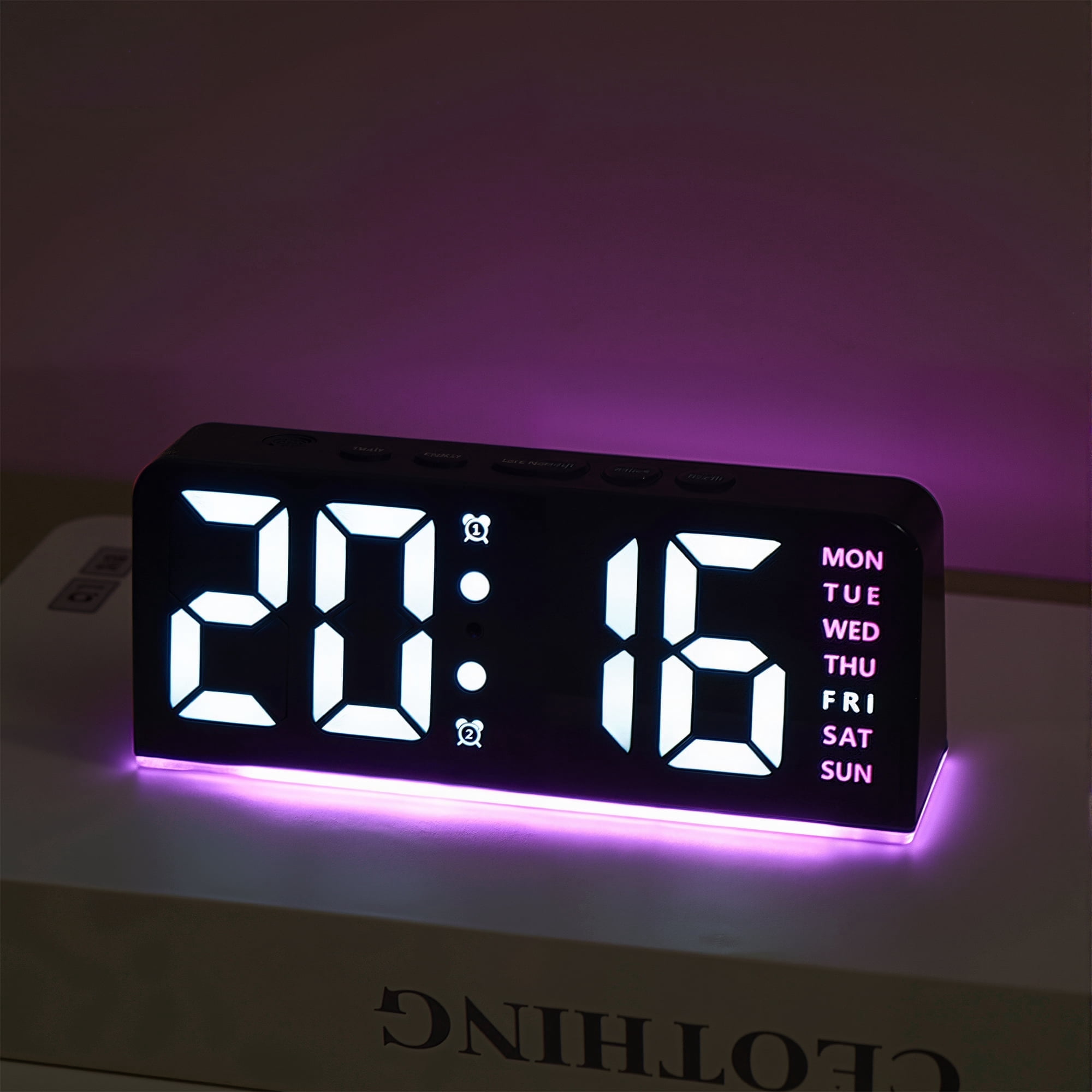
DAYBETTER Small Digital Clock with Night Light, Desk Alarm Clocks for Bedrooms, Heavy Sleepers, Kids

Folding Travel Clock with Mirror Stand
Overview
NOKLEAD NK5247 is a black folding travel alarm clock whose mirror lid doubles as a tabletop stand. It measures 3.54 inches wide by 3.35 inches high, with a separate size field of 3.56 by 3.35 by 0.51 inches, and weighs 0.21 lb.
Key Features
- One CR2032 battery is required and listed as included.
- It provides one alarm, one volume level, 12/24-hour time, snooze, and a weekend mode.
- The square plastic body folds flat, while the mirror cover serves as the tabletop stand.

Considerations
A single fixed volume may not suit heavy sleepers or shared rooms. The current source does not state display brightness, backlight behavior, alarm loudness, snooze length, or the provider and terms of its listed limited warranty. Confirm those points if they affect travel use.
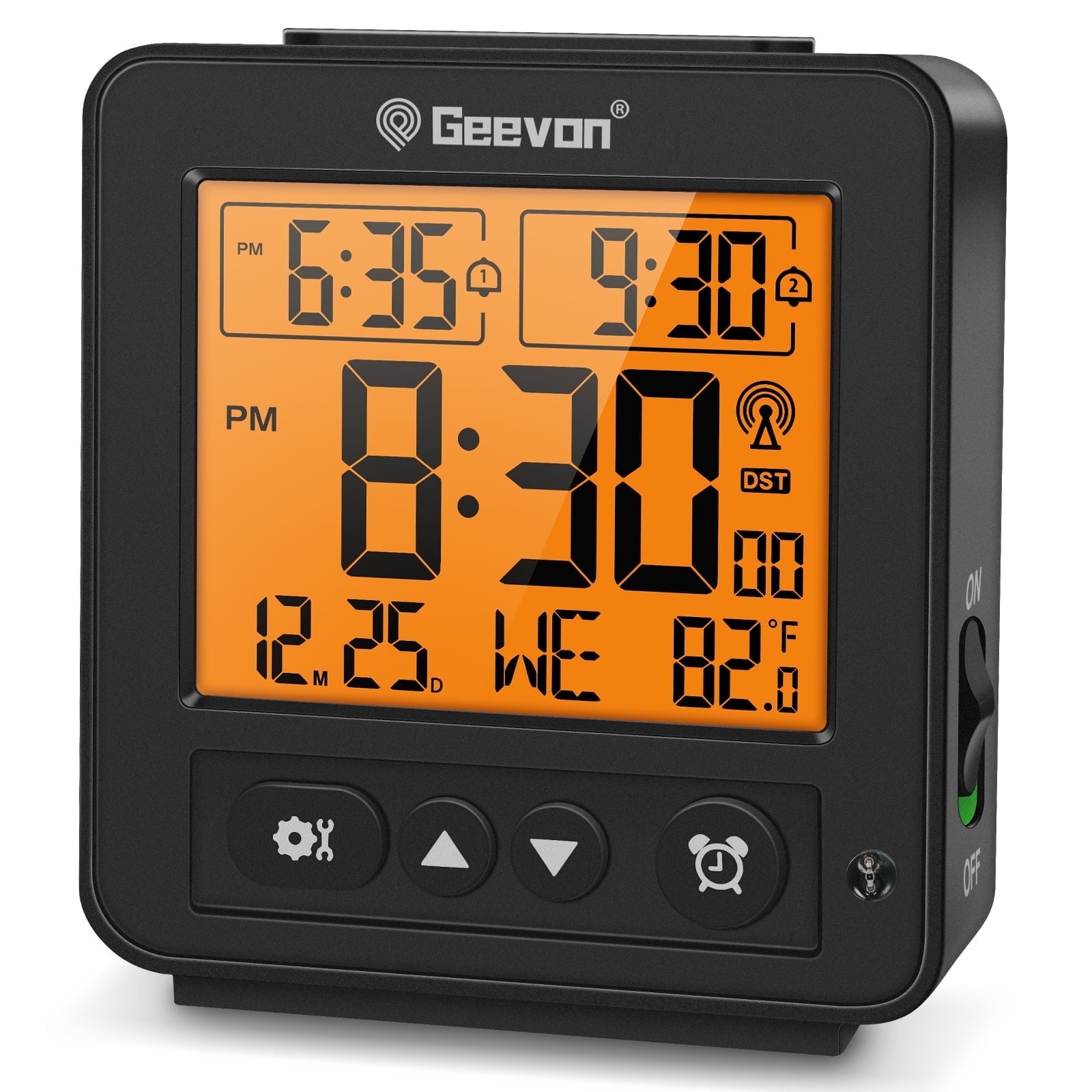
Geevon Small Digital Atomic Alarm Clock for Bedroom, Battery Operated Travel Alarm Clock with Auto/8s...
Choose Normal Power Before Backup Power
DreamSky, Netzu, Sharp, and DAYBETTER are primarily outlet-powered. DreamSky's two AAA cells operate the alarm during an outage but leave the display dark. Sharp's 9V battery stores time and alarm settings and also leaves the display unlit. Netzu does not document backup, and DAYBETTER does not state whether any battery retention exists. These models need an outlet for their normal visible display.
Acedeck Red and Blue can run from four AA alkaline batteries or an optional USB-C connection. Bomivoi and Temracha use three included AAA cells for normal cordless operation. Betus is battery operated but omits type and count. JOUJONG lists outlet or rechargeable-battery power without specifying the pack. Check whether “battery” means full operation, alarm-only outage support, or memory retention before relying on a clock during travel or power failure.
Compare Display Lighting and Night Controls
DreamSky offers five brightness levels plus Off on 1.8-inch digits. Netzu has four levels plus Off. Both Acedeck variants combine three manual settings, display Off, and ambient auto-dimming on 1.8-inch numerals. Sharp uses a smaller 0.6-inch red LED and does not document a dimmer. DAYBETTER pairs a 2.15-inch display with a separate blue night light; each can be adjusted, and the time display can be turned off.
Betus has an LCD but explicitly lacks a backlight. Bomivoi and Temracha describe five-second lighting for short nighttime checks, plus automatic dimming language that is not fully explained. JOUJONG uses a brightness wheel. Display size alone does not establish readability: color, viewing angle, room light, distance, and whether the screen stays lit on battery all affect bedside use.
Match Alarm Scheduling to the Routine
DreamSky combines five volume levels, a two-minute alarm, and nine-minute snooze. Both Acedeck colors list three volume choices and a ten-minute snooze. Sharp provides large top alarm and snooze controls but omits timing and volume details. Betus includes an alarm, timer, and snooze without documenting their ranges. DAYBETTER adds dual alarms and a workday mode, while its snooze duration remains unspecified.
Bomivoi and Temracha describe selectable weekday, daily, weekend, or single-day patterns with five-minute snooze; this is scheduling logic, not proof of five alarms sounding independently. JOUJONG is the only radio-wake model and adds a sleep timer, but preset, timer, and snooze details are absent. Seller labels such as loud or suitable for heavy sleepers are not substitutes for measured output and should not determine placement near another sleeper.
Use Size and Extra Data as Secondary Filters
Betus is the thinnest documented travel form at 3 by 3.4 by 0.5 inches and folds into its own stand. Sharp is 4.63 by 1.95 by 2.8 inches. DreamSky and Netzu are about six inches wide, and the two Acedeck descriptions place their bodies near 5.5 inches wide. Temracha gives only a 5.9-inch width; Bomivoi, JOUJONG, and DAYBETTER lack complete case dimensions in the saved data.
Netzu, Betus, Bomivoi, Temracha, and DAYBETTER add temperature and date information, although none provides an independent temperature-tolerance result. DreamSky and DAYBETTER offer USB device charging, and JOUJONG adds USB plus FM radio and a headphone jack. Extra data and ports can reduce the need for another bedside device, but they also introduce specifications—sensor location, output rating, tuning behavior, and power dependence—that the current listings often leave incomplete.
Alternatives to Led Small Alarm Clocks
Best Led Small Alarm Clocks

Best Compact Disc Digital Alarm Clocks

Best Cube Mini Led Wooden Digital Alarm Clocks