

- Typical shaft lengths: 16 mm (short) and 23 mm (long); measure total shaft and thread length before buying.
- Photograph hands in place, note hand positions, and store original hands flat to avoid warping.
Quick picks
Compact replacement picks


Quick check Quick visual clues to pick the right replacement path
Fast triage: identify the movement family
A quick visual triage separates three movement families and shows immediate replacement consequences.
First look: visible clues
- Battery / quartz: battery compartment visible at the back, a single center shaft, often a second hand that ticks once per second.
- Mechanical (pendulum, non-chiming): winding arbors or keyholes in the dial, a visible pendulum leader or suspension spring, an audible rhythmic tick faster than one-per-second.
- Chiming / grandfather: weights or chains, a long pendulum, and multiple winding holes (commonly three) or a large multi-train movement visible through the case.
Immediate replacement consequences
- Quartz: usually a plug‑in movement swap — confirm shaft length and hand hole sizes; seconds-hand types and dial adapters matter.
- Mechanical pendulum: need a movement with matching suspension spring, crutch alignment and pendulum leader; dial mounting and arbor spacing must match.
- Chiming/grandfather: often require like‑for‑like chime/strike trains, compatible gearing, and case accommodations; professional replacement recommended.
Photograph the dial and measure shaft length before removal.
Battery visible = quartz. Weights/chains = chiming/grandfather. Keyholes or pendulum without weights = mechanical. Photograph and measure before touching parts.
Identification Photos, measurements, internals, and next steps
Quick ID checklist
Photos and notes
- Take clear, well-lit photos of the clock face, movement from the front and back, and the hand set before removal. Include a ruler or coin for scale.
- Photograph mounting points: keyhole slots, hanger tabs, and whether the movement is glued or screwed.
Measurements and internal features
- Record shaft length, shaft diameter, and whether the shaft is threaded or smooth. Note minute/hour/nut stack order.
- Note power type (battery, mains, weight, or spring), pendulum suspension style, and any visible gear trains or chiming racks.
Next steps
- Compare photos and measurements against pattern libraries and parts lists. For practical guidance on matching and replacement, consult the guide for replacing a clock movement without a model number.
- Keep all photos, measurements, and any serial marks in one folder for reference or when asking suppliers.
Tip: always photograph the movement with hands in different positions and include a close-up of the battery compartment or winding arbor — small details often identify the family.
Checklist
Pre‑purchase measurement checklist
- Dial diameter and center hole
Measure dial diameter and center hole diameter to 0.5 mm. Confirm the movement’s threaded bushing will pass through the center hole with 0.5–1.0 mm clearance; allow ±0.5 mm tolerance for fit.
- Shaft length and thread engagement
Measure shaft protrusion from the finished dial face to the shaft tip; common replacements are ~16 mm and ~23 mm, but verify exact length. Aim for shaft equal to or up to 2 mm longer than measured to accommodate washers, with thread engagement of at least 3–4 full turns (±1 mm tolerance).
- Mounting holes and plate thickness
Record center‑to‑center spacing and hole diameters to 0.5 mm. Check movement bracket thickness against dial thickness so the mounting screws sit flush; acceptable mismatch usually within ±0.5 mm.
- Hand stack and clearances
Measure hour‑hand boss depth and minute hand tube height; target 0.5–1.0 mm clearance between stacked hands and 1.5–3.0 mm clearance from highest hand to glass/bezel. Allow ±0.5 mm when planning washers or spacers.
- Bezel/crystal and dry‑fit
Account for bezel lip and crystal thickness by leaving extra 1.5–3.0 mm above hands. Always dry‑fit movement, hands, and bezel before final installation — see the how to measure a clock dial and mounting holes for detailed photos.
Most failed fits come from small gaps:
Measuring shaft from the movement back instead of the dial face. Forgetting washer stack height when using aftermarket hands. Assuming crystals fit—many require an extra 1.5–3 mm clearance.Always mock‑assemble parts and remeasure after adding washers or a bezel; small errors compound quickly.
Shaft basics Exact measurements guide the mounting choice
Measure shaft length and diameter, record spline shape
Start by measuring the effective shaft length: from the front face of the dial (or its mounting surface) to the tip of the shaft that the hand seats on. If the shaft is threaded, record thread length separately. For detailed examples and common lengths, consult the shaft length reference.
Record shaft diameter with calipers to 0.1 mm and note the spline shape (round, D-shaft, square, serrated). Photograph the spline and measure across flats if present.
Choose a mounting type based on those measures:
- Threaded shaft — best when the dial has a nut; record thread diameter and pitch.
- Press-fit shaft — requires exact diameter and may need a brass bushing.
- Adapter/extension — use when a shaft is too short or diameters mismatch; measure boss depth.
Ordering tolerances to specify:
- shaft diameter: ±0.1 mm
- effective length: ±0.5 mm
- thread pitch and spline profile: exact match
Always note dial thickness and hand hole depth when submitting measurements.
Quick checklist: photo the shaft, measure diameter (0.1 mm), length (0.5 mm), note spline type and thread specs.
Hands & adapters Fit, mount type, and torque considerations
Choosing minute‑hand length, mounts, and adapters
Pick minute‑hand length by working from the dial radius: measure from the center to the outer edge of the minute track and subtract about 1–3 mm to avoid rubbing the bezel or markers. For example, a 10″ dial (5″ radius) commonly takes a 4.75–5.0″ minute hand; see the detailed length guide for quick sizing rules.
Identify mounting type before buying replacement hands. Common fits include tapered friction press‑fit, splined/square arbors, and I‑shaft or round‑hole sleeves. Photograph the shaft and compare to the mounting types reference to determine if an adapter or bushing is needed.
Preserve original hands by photographing orientation, loosening center nuts gently, and storing hands flat with padding. For long or heavy hands, use a higher‑torque movement or lighter hands; otherwise the motor will skip or wear prematurely. Simple fixes include balancing heavy hands, using a high‑torque quartz movement, or adding a compatible adapter sleeve for nonstandard shafts. For places to source spade hands and hole‑size filters, consult the spade hands roundup.


Fits 10″ dials
Spade‑style minute hand (5″) designed for quartz I‑shaft movements; sold as a set suitable for ~10″ diameter dials. AnB Collectibles model commonly used to replace worn minute hands when shaft fit matches an I‑shaft or sleeve adapter is available.
Chime mechanics Technical compatibility and verification
Chiming and grandfather movement checks
Start by confirming the movement’s melody sequence matches the original: Westminster, Whittington, or custom sequences have specific strike counts and timing. Check the snail or cam profile against the original train — mismatched snail depth or cam timing causes extra strikes or missed strikes. For timing specifics, consult the chiming movement timing guide.
Quarter‑chime logic and cams
Ensure the quarter‑chime lever and quarter cam engage at the correct minute positions. On three‑train grandfather movements, verify the chime train, strike train, and time train are synchronized: advance the minute hand slowly through each quarter and let the sequence finish before moving on.
Weight and power considerations
Match weight mass and pulley ratios to the movement’s torque rating. Heavier hands or longer dials need higher torque or larger weights; insufficient power produces slow or missed chimes.
Verification steps:
- Put the movement in beat and set the snail to the zero position.
- Advance minute hand to each quarter, observe full sequence.
- Listen for drift or extra strikes; adjust snail/cam or weight as needed.
Run a full-cycle test: let the chime finish before advancing the hands.
Log which quarter or strike fails to isolate cam or train faults.
Conversion basics Keep the dial and hands, convert the drive
When a quartz conversion kit makes sense
A quartz conversion kit is a good choice when the original mechanical movement is failing but the dial, hands, and case are worth keeping, or when low maintenance and battery power are preferred. Kits are often simpler and quieter than repairing complex trains, but success depends on fit and torque rather than price.
Kit features that decide success
- Shaft length & diameter: must match dial thickness and hand mounts. Measure twice.
- Hand adapters/spline compatibility: original splines may need adapters or replacement arbors.
- Torque (high-torque option): required for heavy or long hands—check the movement spec sheet.
- Mounting plate and shaft thread: ensure the movement can secure inside the case; some conversions require a custom plate.
Pros: quieter, low maintenance, often retains original hands/dial. Cons: may require modification, usually sacrifices mechanical chiming/striking, and some kits are not drop‑in.
For kits that keep original hands on small dials, see the kits that fit small dials and original hands.
One example is the Horace Whitlock HWHM02: a silent‑sweep unit designed for Hermle 2114/2115 conversions—installation guidance stresses measuring shaft length and preparing for minor adjustments.
Silent‑sweep conversion for Hermle 2114/2115
Designed as a conversion for Hermle 2114/2115 and similar units. Features a smooth, silent sweep and compact footprint. Manufacturer notes: conversion required — not a direct drop‑in; confirm shaft length and case mounting before ordering. Part number HWHM02.
Continuous sweep vs quiet‑step
Continuous‑sweep movements keep the second hand moving in a smooth, near‑silent glide by using a scanning motor or microstep drive. Quiet‑step (sometimes marketed as “silent stepper”) reduces audible ticks by lengthening or softening each step; occasional tiny clicks can still occur. Gear rattle, hand‑to‑dial rub, and loose mounting often cause more noise than the motor itself.
Choose the lowest‑noise movement that still meets torque and mounting needs:
- Prefer a high‑torque sweep when using heavy or long hands; torque tradeoffs can slightly raise noise but avoid underpowered stalling.
- Match shaft length/thread to the dial; use long‑shaft variants for thicker dials. Record spline shape before ordering.
- Reduce residual noise with felt washers, a snug (not over‑tightened) nut, and balanced hands.
For side‑by‑side models and real replacement notes, consult the quiet quartz movements compared guide before buying.
Two shaft lengths included
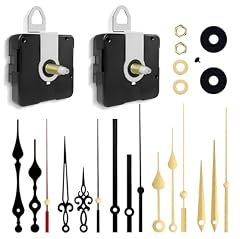
Includes short (16 mm) and long (23 mm) shafts, multiple aluminum hands, and a scanning‑design sweep motor advertised as ultra‑silent. Good fit for 3–13 mm panels; battery not included. Practical for DIY swaps where low noise and shaft options are both required.
Checklist
10-step pre-order and installation checklist
- 1. Confirm movement family
Verify battery, mainspring, or weight-driven—this dictates shaft, suspension, and replacement strategy.
- Re-measure shaft precisely
Confirm effective shaft length, diameter, and spline orientation against ordering tolerances.
- Check hand-seat compatibility
Match minute/second hand mounts to the movement’s spline or adapter; note heavy-hand needs.
- Verify minute-hand length
Ensure clearance to dial markers (usually 1–3 mm gap) and check for interference.
- 5. Confirm torque and load
Match movement torque rating to hand weight, pendulum, or weight train to avoid stalling.
- 6. Match chiming/cam profiles
For striking movements, verify cam shape and sequence to preserve melody and syncability.
- 7. Choose proper mounting hardware
Select a compatible mounting plate, washers, and dial fixings to center the shaft.
- 8. Photograph and label parts
Document dial, hands, and mounting before disassembly to simplify reassembly.
Some mechanisms are specialist territory—torsion suspension springs (e.g., 400‑day designs) and delicate escapements need experienced repair. See the 400‑day suspension spring options and repairs before attempting work; if mainsprings, hardened pivots, or suspension wires are involved, consider professional service.
When to stop
When to consult a professional
- Repeated stalling after correct fitting or broken suspension/mainsprings.
- Chiming trains out of sequence or visible gear/pivot damage.
- Any work that requires disassembling the escapement or re-tempering springs.
If safe bench tests fail or delicate suspension, mainsprings, or escapement adjustments are required, pause and consult a qualified clockmaker. Professional repair prevents further damage and preserves value.